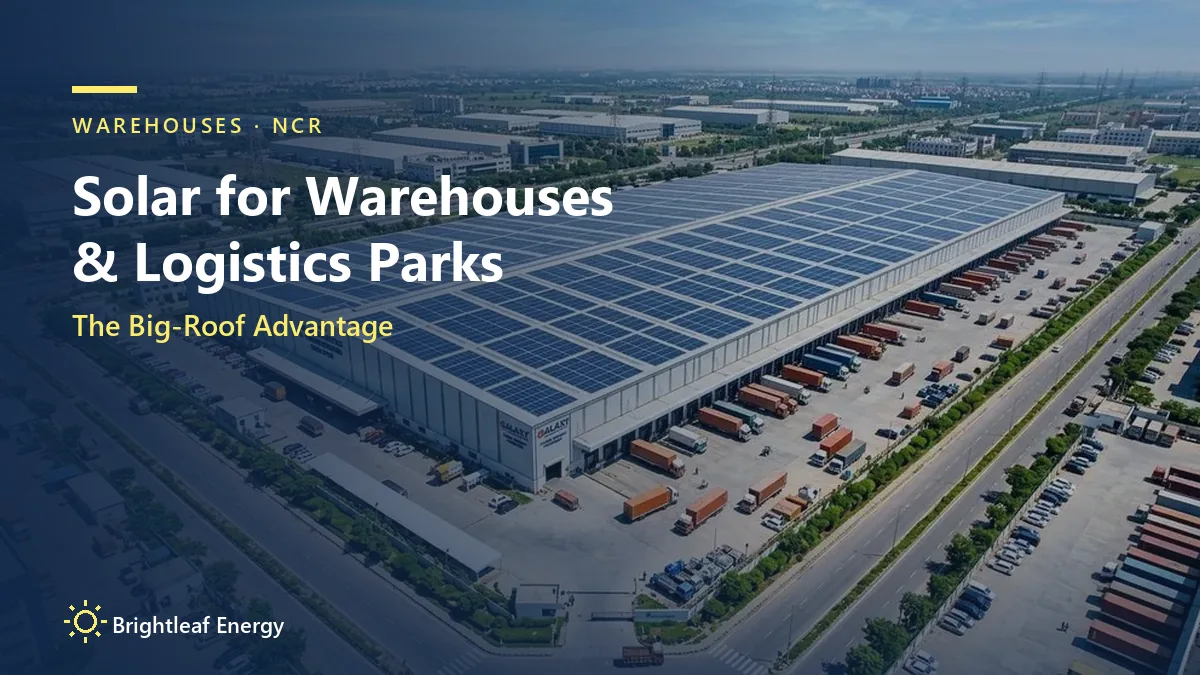
Warehouses and logistics parks are usually the strongest commercial solar economics in Delhi NCR. The reasons are structural, not promotional: a 40,000 sq. ft. logistics shed is a contiguous, mostly shade-free industrial roof; material handling, lighting, charging and cold-room loads run through the solar window; and at 250–500 kW, scale pricing pushes the cost per kW down while the bill being offset is large.
A 250 kW warehouse rooftop plant in NCR costs around ₹92.5 lakh to ₹1.05 crore, generates roughly 31,250 units a month, and offsets about ₹33.75 lakh of electricity a year at a ₹9/unit commercial tariff — a payback of roughly three years. If you are comparing warehouses specifically, this guide covers sizing, metal-roof engineering, net metering and owner-versus-tenant economics, and how we deliver warehouse rooftop solar in Noida and commercial solar in Greater Noida.
Last updated: October 2026. Figures are indicative NCR planning ranges, not quotations. Generation assumes ~1,500 units per kW per year (4.2–4.5 peak sun hours/day); actual output depends on shading, roof condition and system uptime.
rooftop solar vs traditional electricity 10-year ROI, solar panels for business ROI, solar panels for hotels and banquet halls and solar blogs and guides.
On a PEB warehouse, the mounting detail is where cheap EPC work fails. Fixing into thin sheeting instead of structural purlins voids roof warranties and leaks within a monsoon or two. Demand the roof-specific mounting drawing before you sign.
Why Warehouse Roofs Work So Well For Solar
Large, contiguous, shade-free roof
Warehouse eaves are tall, columns are widely spaced and there are rarely the water tanks, stair cores and equipment banks that fragment an office roof.
Loads that align with generation
Lighting, forklifts and charger banks, conveyors, sorters, packing equipment, security systems and — in many facilities — HVAC and cold rooms all draw power between 9 am and 5 pm, exactly when the array produces.
Scale pricing
At 250–500 kW, per-kW cost drops toward ₹36,000–42,000 because design, approvals and mobilisation are shared across far more capacity.
High commercial tariffs
NCR industrial and commercial tariffs sit roughly ₹8–11/unit, while solar's levelised cost is around ₹2.20–3.00 per unit.
Net metering absorbs the slack
Weekend and night-shift dips in consumption are covered by credit for exported daytime units, so you are not penalised for over-sizing.
NCR Warehouse & Logistics Belts
| Belt | Typical facilities | Typical system size |
|---|---|---|
| Noida industrial sectors | Warehouses, logistics centres, electronics assembly, IT parks | 100 kW – 500 kW |
| Greater Noida — Ecotech, Kasna, Surajpur | Logistics parks, warehousing, mega facilities, utility-scale | 250 kW – 1 MW |
| Ghaziabad — Sahibabad Site IV, Bulandshahr Road, Loni, Tronica, Kavi Nagar, Dasna, Indirapuram | Warehousing, cold chain, manufacturing with sheds | 100 kW – 500 kW |
| Gurugram — Sohna Road corridor, Badshahpur, Sohna logistics parks, Pace City Sectors 34 & 37 | Fulfillment centres, cold storage, industrial warehousing | 100 kW – 500 kW |
| Faridabad — Sector 24 & 25, Ballabhgarh, NIT Faridabad, Mathura Road, Prithla | Fabrication, automotive, warehousing | 100 kW – 250 kW |
Sizing differs by belt because roof typology and utility route differ. Ghaziabad and Faridabad sheds are generally smaller than the Greater Noida mega-facilities, and the DISCOM changes with the pin code — see our commercial solar in Ghaziabad and commercial solar in Faridabad pages for local interconnection detail.
What A Warehouse Actually Consumes
Understanding the daytime load profile is what separates a well-sized warehouse system from an oversized one:
| Load | Typical operating window | Solar relevance |
|---|---|---|
| High-bay and external lighting | Evening/night, plus daylight zones | Partly offset in daytime |
| Forklifts, pallet trucks, battery chargers | Shift hours | Strong direct match |
| Conveyors, sorters, packing lines | Shift hours | Strong direct match |
| Cold rooms / refrigeration | 24×7, heavy afternoon load | Excellent match — peak cooling coincides with peak generation |
| Office and HVAC in mezzanines | Daytime | Good match |
| Security, gates, docks, EV charging | 24×7 / intermittent | Partial |
Where a warehouse runs night shifts, the system is usually sized to the daytime load with net metering carrying the rest. Where it runs a single day shift with a strong refrigeration load — the classic cold-chain case — a larger array self-consumes almost entirely.
Cold chain is the best case: peak refrigeration load coincides with peak generation in the afternoon, so a cold store or food-processing shed self-consumes more of every kWh than a dry warehouse with a single day shift.
Typical Warehouse Project Sizes And Economics
| Capacity | Indicative cost | Roof area | Monthly generation | Annual savings at ₹9/unit | Payback |
|---|---|---|---|---|---|
| 100 kW | ₹38.0 L – ₹44.0 L | ~8,000 sq. ft. | ~12,500 units | ~₹13.5 L | ~3.1 yrs |
| 250 kW | ₹92.5 L – ₹1.05 Cr | ~20,000 sq. ft. | ~31,250 units | ~₹33.75 L | ~3.0 yrs |
| 500 kW | ₹1.80 Cr – ₹2.05 Cr | ~40,000 sq. ft. | ~62,500 units | ~₹67.5 L | ~2.9 yrs |
| 1 MW | ₹3.50 Cr – ₹3.90 Cr | ~80,000 sq. ft. | ~1,25,000 units | ~₹1.35 Cr | ~2.8 yrs |
Note on estimates: These are market planning ranges for turnkey grid-connected EPC work. Payback figures assume a ₹9/unit commercial tariff, full net-metering credit settlement, and 40% Year-1 depreciation under Section 32 supporting early cash flow. A poorly shaded, structurally sound warehouse sits at the faster end; a roof with heavy equipment or partial night operations sits at the slower end.
For the line-by-line cost split on a mid-sized plant, see our 100 kW solar system price breakdown.
Engineering On Metal Shed Roofs: The Part That Matters Most
Most NCR warehouses are Pre-Engineered Buildings (PEB) with trapezoidal or standing-seam metal roofing. This is where cheap EPC work fails and where you should be most demanding:
Standing-seam aluminium clamps attach to the sheet crown without drilling into purlins, preserving both waterproofing and the roof manufacturer's warranty.
EPDM-gasketed rivet fixtures with double sealant layers, on structural purlins only — never on thin sheeting.
Warehouse roofs are designed for dead load and wind, not for a distributed solar array plus maintenance walkways. A structural audit of purlin spans and load paths is non-negotiable before layout is frozen.
NCR corridors see gusts that have reached 160 km/h in exposed industrial belts. Fixings, edge zones and module orientation are engineering decisions, not catalogue options.
A roof within its last few years of life will probably need re-sheeting or re-coating in the system's lifetime — sequence that work together, not separately.
Long-term array life depends on safe module cleaning and service access. Elevated walkways add cost and extend asset life.
Site And Structural Checks Before Any Quotation
Usable, shadow-free roof area measured with a drone or 3D rooftop survey.
Roof type, sheet profile, purlin spacing and age.
Structural load capacity — dead and live loads, with added solar and walkway loads.
3D shading profile from vents, water tanks, ducts and neighbouring structures.
Distance and route from array to LT/HT panel room or transformer.
Existing switchgear capacity and whether the feeder can absorb export.
Roof water-tightness warranty status.
Construction phasing that does not interrupt dispatch and operations.
Net Metering For Warehouses And Logistics Parks
Warehouse economics depend on being able to bank surplus generation, so the DISCOM position matters as much as the module price:
- Haryana (DHBVN — Gurugram, Faridabad). Commercial rooftop systems can be installed up to 100% of sanctioned connected load, with a regulatory cap of 500 kW for net-metered installations. Surplus power is recorded through a four-quadrant bi-directional TOD meter and credited on the monthly bill, with credits rolling across billing cycles.
- Uttar Pradesh (PVVNL — Noida, Ghaziabad; NPCL — Greater Noida). Grid-connected rooftop solar up to 100% of sanctioned load, with exported units adjusted against the monthly bill under the UP Solar Power Policy. Plants above 50 kW are typically connected at 11 kV or 33 kV with dual-protection relays.
- Statutory clearances. Plants above 100 kW — and any HT-connected plant — need electrical drawing approval and inspection from the Chief Electrical Inspector to the Government (CEIG) alongside the utility’s net metering sanction.
- Weekend export is not wasted. In facilities that run lighter on Sundays or holidays, exported units offset the following week’s peak billing.
Our commercial net metering guide for Delhi NCR compares BSES, DHBVN and PVVNL rules side by side.
Owner Or Tenant? Who Should Buy The System
This is the first question in every warehouse conversation, and it is rarely a technical one:
If you own the building, CAPEX ownership maximises lifetime savings, captures 40% Year-1 depreciation, and adds a saleable asset to the property. Typical payback: 3–4 years.
If you lease, a RESCO/OPEX structure lets the investor own the plant and sell you power at 20%–40% below your DISCOM rate with zero capital outlay — appropriate when a 10–25 year occupancy horizon is uncertain.
If you lease but intend to stay, it is worth modelling the CAPEX case anyway; with strong savings and a defined tenure, ownership often wins despite the higher upfront commitment.
Check the lease. Roof rights, access rights, structural modification permissions and end-of-term treatment of the plant all need to be unambiguous before installation.
For the full financial comparison, see our CAPEX vs OPEX vs RESCO guide.
How To Choose An EPC For Warehouse Projects
Ask for structural drawings, not brochures. Any credible bidder will share the mounting structure design and the load audit.
Demand roof-specific mounting detail. Standing-seam clamps versus gasketed penetrations must be written into the quote.
Check industrial experience. Warehouse work is not the same as a 20 kW office installation — ask for comparable shed-roof references.
Verify the approval plan. Net metering filing, CEIG drawings, HT interconnection scope, and who owns each task.
Confirm the O&M plan. NCR dust and particulate can degrade output 15–25% without disciplined cleaning; ask what the AMC includes and how response times work.
Read the warranty stack. Module performance warranty, inverter warranty, workmanship warranty, and the performance guarantee offered.
Dry warehouses
Day-shift material handling and lighting give a strong direct match; size to daytime load.
Cold chain & food
Afternoon refrigeration peak coincides with generation — the highest self-consumption case.
Logistics parks
Large contiguous roofs support 500 kW–1 MW; net metering caps decide the optimal split.
Frequently Asked Questions (FAQs)
Is solar practical on a warehouse metal shed roof?
Yes. PEB and trapezoidal sheds take arrays using non-penetrating standing-seam clamps, or EPDM-gasketed rivet fixtures with double sealant layers fixed into purlins. The design must be certified for the specific roof profile and local wind loads.
How much solar does a warehouse need?
Most NCR warehouses land between 100 kW and 500 kW depending on roof area and daytime load. A 40,000 sq. ft. shed typically supports a 500 kW array at about 80 sq. ft. per kW.
Can warehouses use net metering in Delhi NCR?
Yes. Commercial rooftop solar up to 100% of sanctioned load is permitted, subject to the regulatory framework of your utility — including a 500 kW cap on net-metered installations under Haryana's rules — with surplus units credited through a bi-directional meter.
What if our warehouse runs night shifts only?
Solar then mainly offsets your contract demand charges and daytime auxiliary loads, and you export most of the generation. The business case shifts from bill-offset to demand-charge reduction — worth modelling, but size the array to the daytime load rather than the roof.
We are only a tenant — should we still install solar?
Usually through a RESCO/OPEX structure where the investor owns the plant and bills you a discounted tariff. Confirm your lease permits roof installation and access before proceeding.
How much can warehouse solar save on electricity bills?
At a ₹9/unit tariff, a 250 kW system offsets about ₹33.75 lakh a year and a 500 kW system about ₹67.5 lakh. Higher tariffs and heavier daytime loads — cold chain being the clearest case — push savings toward the upper end.
What is the payback period for warehouse solar?
Typically 3–4 years for CAPEX projects in NCR, faster where tariffs are higher, generation is fully self-consumed or net-metering credits settle promptly, and where the 40% Year-1 depreciation shield is usable.
Sources & Official References
- Ministry of New and Renewable Energy (MNRE)
- Haryana Electricity Regulatory Commission (HERC)
- DHBVN — solar net metering portal
- Uttar Pradesh Electricity Regulatory Commission (UPERC)
- PVVNL — Paschimanchal Vidyut Vitran Nigam
Costs, tariffs, net metering caps and structural requirements are subject to change and to site/DISCOM approval. Verify against the official portals above and with a structural engineer before relying on any figure.