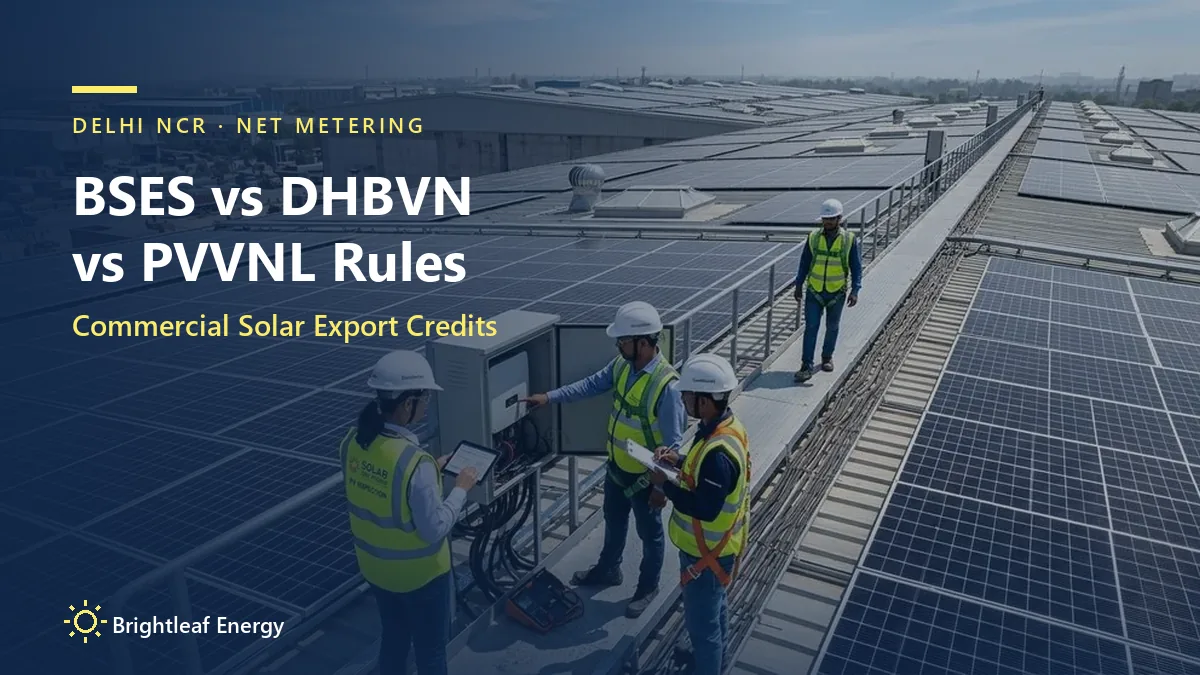
Net metering lets a commercial consumer export surplus rooftop solar into the grid and receive it back as bill credit through a bi-directional meter. Across Delhi NCR it is available under all three utility families — Delhi (BSES Rajdhani, BSES Yamuna and Tata Power-DDL), Haryana (DHBVN) and Uttar Pradesh (PVVNL, plus NPCL in Greater Noida) — generally up to 100% of your sanctioned load, with Haryana applying a 500 kW regulatory cap on net-metered installations.
Rules differ enough between utilities that a project designed for one can stall in another. This guide compares them side by side and links to city-level detail: commercial solar for Delhi businesses, PVVNL net metering support in Noida, commercial solar in Greater Noida under NPCL, commercial solar in Ghaziabad, commercial solar in Faridabad and DHBVN net metering up to 500 kW in Gurugram.
Last updated: October 2026. Regulatory frameworks and utility processes change. Treat everything below as a working summary to plan against, and confirm current caps, forms and charges with your DISCOM division or your chartered accountant at the feasibility stage.
home solar installation step-by-step guide, solar installation process in India, solar payback period and cost recovery time and solar blogs and guides.
The single biggest cause of delay is incomplete documentation, not engineering. A mismatch between the name on the electricity bill and the entity applying for the meter, a missing lease or ownership document, or an unsigned single-line drawing can add weeks to a project that is otherwise ready to build.
What Net Metering Actually Does
A grid-connected commercial solar system has two energy flows. Units your building consumes during the day are consumed directly on site. Anything more — during a weekend, a holiday, or a light-load period — flows out through the meter and is recorded as export. Under net metering, that exported energy is credited back against your consumption in subsequent billing periods, so surplus generation is banked rather than wasted.
Without a net metering arrangement, an oversized array earns nothing beyond its own self-consumption. That is why the DISCOM framework, not the module price, determines whether a large commercial system is financially sensible.
Import and export
A bi-directional meter records both flows separately, so the utility can bill import and credit export in the same billing cycle.
Capacity, not roof size
Sanctioned load and feeder capacity decide how much you may install — not the square footage of the roof.
The Comparison At A Glance
| Parameter | Delhi (BSES Rajdhani, BSES Yamuna, Tata Power-DDL) | Haryana (DHBVN) | Uttar Pradesh (PVVNL — Noida, Ghaziabad) | Greater Noida (NPCL) |
|---|---|---|---|---|
| Governing framework | DERC green energy / net metering regulations for the licensed DISCOMs | Haryana rooftop solar regulations under HERC; Haryana Solar Policy | Uttar Pradesh Solar Power Policy | UP Solar Policy, administered by NPCL |
| Eligible consumer | Commercial, industrial and institutional connections | Commercial, industrial and institutional connections | Commercial, industrial and institutional connections | Commercial, industrial and institutional connections |
| Capacity basis | Sanctioned load / contract demand, subject to current regulations | Up to 100% of sanctioned connected load / contract demand | Up to 100% of sanctioned connected load | Up to sanctioned load, per NPCL process |
| Net-metered capacity cap | Confirm current limit with the DISCOM division during feasibility | Regulatory cap of 500 kW for net-metered installations | Policy-based limits apply; larger consumers shift toward gross metering | Policy-based limits apply |
| Metering | Bi-directional meter | Four-quadrant bi-directional TOD meter | Bi-directional meter | Bi-directional meter |
| Credit mechanism | Export recorded and adjusted in the billing cycle | Monthly kWh credits that roll forward through the financial year | Exported units adjusted against the monthly bill, rolled forward to annual settlement | Exported units credited at approved UPERC tariff benchmarks |
| HT interconnection | Per utility requirement for larger plants | Plants above 50 kW typically at 11 kV / 33 kV with dual-protection relays | Plants above 50 kW at 11 kV / 33 kV with dual-protection relays | Per NPCL requirement for larger plants |
| CEIG involvement | Electrical safety clearance per current rules | Drawing approval and inspection for plants above 100 kW or on 11/33 kV HT | Electrical safety approvals via CEIG for applicable capacities | Electrical safety approvals via CEIG for applicable capacities |
| Application route | Utility portal / division office | DHBVN Solar Portal (sfa.dhbvn.org.in) | PVVNL division office / portal | NPCL division office / portal |
| City support | Delhi belt | Gurugram, Faridabad | Noida, Ghaziabad | Greater Noida |
Summary only. Capacity caps, credit settlement and documentation requirements should be confirmed with the specific division before layout is frozen.
Delhi: BSES Rajdhani, BSES Yamuna And Tata Power-DDL
Delhi’s commercial net metering is administered by the three licensed distribution companies under the DERC green energy framework, which sets the eligibility, metering and settlement rules alongside the rooftop solar incentive framework for the city.
In practice for a business:
- The bi-directional net meter is the deliverable that unlocks export credits, and it is installed after technical feasibility approval.
- Commercial payback in Delhi typically runs 3–6 years, driven by tariff level, self-consumption ratio and whether the 40% Year-1 depreciation under Section 32 is usable against your profits.
- Both CAPEX and RESCO models work in Delhi; a RESCO structure is common where the building is leased.
- Export limits and capacity caps are regulatory, not negotiable — they should be confirmed with your specific division before the array layout is frozen, because they determine your system size.
Brightleaf’s Delhi team handles documentation, feasibility applications and DISCOM coordination end to end, so your project does not stall in an approval queue. See the Delhi commercial solar page for the local process.
Haryana: DHBVN And The 500 kW Cap
Haryana’s framework is the most explicit of the three, which makes Gurugram and Faridabad projects straightforward to plan.
- Capacity: commercial rooftop solar up to 100% of sanctioned connected load or contract demand, with a regulatory cap of 500 kW for net-metered installations.
- Meter: four-quadrant bi-directional TOD (Time of Day) meter.
- Settlement: exported units are credited on the monthly bill, with kWh credits rolling forward through the financial year — so a weekend’s surplus offsets a weekday’s peak.
- Application: filed online through the DHBVN Solar Portal (sfa.dhbvn.org.in), followed by processing fee payment and technical feasibility approval.
- CEIG: electrical drawing approval and inspection from the Chief Electrical Inspector to the Government of Haryana are required for plants above 100 kW or on 11 kV / 33 kV HT supplies.
Site survey and structural audit (days 1–3) → PV engineering and SLD (days 4–7) → portal filing and feasibility (days 8–18) → CEIG drawing approval (days 19–28) → installation and earthing (days 25–45) → CEIG inspection and net-meter commissioning (days 45–55) → energisation and SCADA handover (~day 60).
For a detailed view of how this plays out on a Gurugram industrial rooftop, see DHBVN net metering up to 500 kW in Gurugram, and the Faridabad equivalent on our commercial solar in Faridabad page.
Uttar Pradesh: PVVNL And NPCL
Noida, Ghaziabad and Greater Noida sit under UP policy but different licensees.
PVVNL (Noida, Ghaziabad)
- Commercial and industrial consumers can install grid-connected rooftop solar up to 100% of sanctioned connected load.
- Net metering and gross metering both operate under the UP Solar Power Policy — the arrangement that fits your capacity and load profile determines which applies.
- A bi-directional meter records import and export; exported units are adjusted against your monthly bill, with credits carried forward across billing cycles to the annual settlement.
- Plants above 50 kW are typically connected at 11 kV or 33 kV with dual-protection relays, so the electrical scope includes switchgear and protection coordination.
- CEIG electrical safety approvals apply for relevant capacities, alongside PVVNL paperwork, transformer capacity verification and meter testing.
NPCL (Greater Noida)
- Net metering for businesses under NPCL, with surplus generation credited against the bill cycle at approved UPERC tariff benchmarks.
- Greater Noida’s industrial belts — Ecotech, Kasna and Surajpur — frequently run projects at 250 kW to 1 MW, which makes open-access or behind-the-meter routes relevant once net-metered limits are reached.
- Our commercial solar in Greater Noida page covers the utility-scale and mega-facility case.
The Approval Journey, In Order
Every utility follows the same logical sequence even when the paperwork differs:
Site survey and structural audit — roof type, load capacity, shading, distance to the panel room.
System design and SLD — string layout, cable routing, single-line drawings, protection coordination.
Net metering application — portal filing or division submission, processing fee, technical feasibility approval.
Statutory clearances — CEIG drawing approval and inspection where applicable.
Equipment procurement and installation — modules, inverters, structure, cabling, earthing, SPDs.
Meter commissioning — bi-directional or four-quadrant TOD meter installed and tested; flash and insulation-resistance tests completed.
Synchronisation and energisation — grid sync certificate, performance test, SCADA/monitoring handover.
The single biggest cause of delay is incomplete documentation, not engineering. A mismatch between the name on the electricity bill and the entity applying for the meter, a missing lease or ownership document, or an unsigned single-line drawing can add weeks.
What Happens Above 500 kW
The 500 kW regulatory cap in Haryana, and policy-based limits elsewhere, are where net metering stops being the natural fit. Above those limits, businesses typically evaluate:
- Gross metering, where exported units are settled as a separate transaction rather than netted against consumption.
- Open access / group captive, where a larger plant injects into the grid and the consumption is supplied under a separate arrangement — common for utility-scale plants in the Greater Noida and Noida industrial belts.
- Behind-the-meter expansion, splitting capacity between a net-metered rooftop portion and a larger behind-the-meter or captive configuration.
Large sheds in these belts follow the warehouse playbook — see our solar for warehouses and logistics parks in NCR guide for sizing and metal-roof engineering.
Documents To Keep Ready Before You Apply
Most net metering delays are administrative, not technical. Keeping this set assembled before the application goes in will compress the timeline:
| Document | Why it is needed |
|---|---|
| Latest electricity bills (ideally 3–12 months) | Establishes sanctioned load, contract demand, tariff slab and account holder |
| Proof of building ownership or lease agreement | Net metering is registered against the account holder's premises |
| Approved building drawing / property tax record | Site identification for the utility's survey and inspection |
| Single-line diagram (SLD) of the proposed system | Technical submission accompanying the grid-connection application |
| GST registration and company details | Standard for commercial and industrial connections |
| Authorised signatory ID proof | Signatures on the application and the net metering agreement |
| Structural and roof details, with load audit | Technical feasibility review by the utility/inspectorate |
| CEIG drawings for plants above 100 kW or on HT | Statutory approval before commissioning |
The most common rejection cause is a mismatch between the name on the electricity bill, the entity applying for the meter, and the signatory on the agreement. Align all three before filing.
Practical Gotchas Worth Knowing Before You Design
Sanctioned load is the ceiling
If your sanctioned load is small but your roof is enormous, array size is limited — verify sanctioned load and contract demand before finalising layout.
Name on the bill matters
Net metering is registered against the electricity account holder. Tenants need the owner's consent and a documented arrangement.
Feeder capacity can bind before policy does
Distribution transformer capacity is verified by the utility; an export limit can be imposed even where policy allows the capacity.
Approval sequencing matters
Installing before the meter sanction can mean the system sits energised but unbilled, or needs re-testing.
Seasonal and site constraints
Monsoon inspections and rooftop access windows affect scheduling; plan the timeline accordingly.
Frequently Asked Questions (FAQs)
Is net metering available for commercial solar in Delhi?
Yes. Commercial rooftop solar under Delhi's licensed DISCOMs — BSES Rajdhani, BSES Yamuna and Tata Power-DDL — operates under the DERC green energy framework, with export recorded through a bi-directional meter and credited against consumption. Current capacity caps and credit terms should be confirmed with your division at the feasibility stage.
What is the maximum capacity for commercial net metering under DHBVN?
Commercial and industrial consumers under Haryana's regulations can install grid-connected rooftop solar up to 100% of their sanctioned load or contract demand, with a regulatory cap of 500 kW for net-metered installations.
How is exported solar credited on my bill?
Export is recorded through a bi-directional meter (four-quadrant TOD meters in Haryana) and credited in kilowatt-hours against your consumption. Credits roll forward across billing cycles — in Haryana through the financial year, under UP policy until the annual settlement.
Do I need CEIG approval for commercial solar?
For plants above 100 kW and for HT-connected systems at 11 kV or 33 kV, electrical drawing approval and inspection from the Chief Electrical Inspector to the Government (CEIG) are required alongside the utility's net metering sanction. Your EPC typically handles this liaison.
Can I install more solar than my sanctioned load?
Generally no — systems are installed up to 100% of sanctioned connected load. Beyond that, the economics shift to gross metering or open-access arrangements rather than rooftop net metering.
How long does commercial net metering approval take?
Typically a few weeks for the utility process plus a few days to weeks for CEIG clearances where applicable. A well-managed commercial project in NCR moves from site survey to grid commissioning in about 8–12 weeks.
Does net metering change the payback period?
It changes the project fundamentally. Net metering is what allows an array larger than your daytime load to still earn — surplus becomes bill credit instead of wasted generation. Without it, oversized commercial systems lose their economic case.
We are tenants — can we still get net metering?
Yes, provided the electricity account holder (usually the owner) consents and the arrangement is documented. Many tenants use a RESCO/OPEX structure, where the investor owns the plant and the host pays for the power.
Sources & Official References
- Delhi Electricity Regulatory Commission (DERC)
- BSES Delhi (Rajdhani & Yamuna Power)
- Haryana Electricity Regulatory Commission (HERC)
- DHBVN — solar net metering portal
- Uttar Pradesh Electricity Regulatory Commission (UPERC)
- PVVNL — Paschimanchal Vidyut Vitran Nigam
Tariffs, capacity caps and approval processes are subject to change and to DISCOM approval. Verify against the official portals above before relying on any figure.