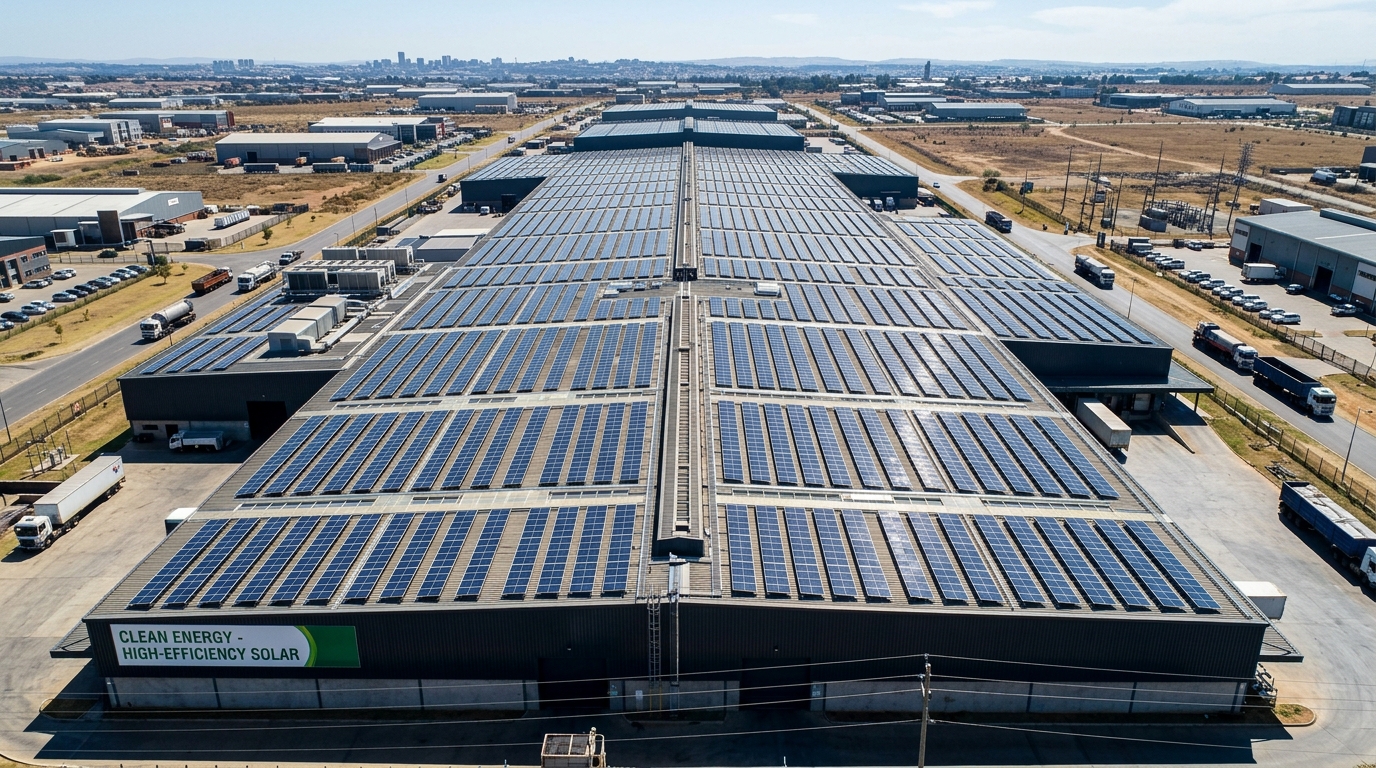
If you are searching for the commercial solar system cost in India, the honest answer is a range, not a single price. A turnkey on-grid commercial solar plant in India in 2026 typically costs between ₹38,000 and ₹48,000 per kW for systems of 100 kW and above, with smaller systems (10–50 kW) landing higher because fixed engineering, approval and installation costs are spread across fewer kilowatts.
Every roof, load profile and DISCOM is different, so the only quote that matters is the one built on your site survey. Brightleaf Energy builds its commercial solar solutions for businesses on that principle — a measured design, not a price list.
This guide gives you the 2026 planning numbers, a transparent cost stack, and the questions that separate a genuine turnkey quote from an inflated one.
Commercial projects of 100 kW and above in Delhi NCR typically recover capital in 3 to 4.5 years. Claim 40% accelerated depreciation under Section 32 in Year 1 to bring the effective net outlay down 20%–30%. Figures in this guide are indicative 2026 planning ranges, not quotations.
Commercial Solar System Cost in India: The Quick Answer
| System size | Indicative turnkey cost | Indicative price per kW |
|---|---|---|
| 10 kW | ₹5.5 L – ₹6.5 L | ₹55,000 – ₹65,000 |
| 20 kW | ₹10.0 L – ₹12.0 L | ₹50,000 – ₹60,000 |
| 50 kW | ₹21.0 L – ₹27.0 L | ₹42,000 – ₹54,000 |
| 100 kW | ₹38.0 L – ₹48.0 L | ₹38,000 – ₹48,000 |
| 250 kW | ₹92.5 L – ₹1.20 Cr | ₹37,000 – ₹48,000 |
| 500 kW | ₹1.80 Cr – ₹2.40 Cr | ₹36,000 – ₹48,000 |
| 1 MW (1,000 kW) | ₹3.50 Cr – ₹4.80 Cr | ₹35,000 – ₹48,000 |
Note on estimates: These are Delhi NCR market ranges for turnkey, grid-connected commercial EPC work in 2026, excluding land cost and any consumer-specific GST credit. A 100 kW plant quoted at ₹38–44 lakh and a 500 kW plant at ₹1.80–2.05 crore are both normal outcomes for well-optimised projects; anything far outside these bands usually means something is missing from — or added to — the scope.
What Is Included In A Turnkey Commercial Solar Quote?
A genuine EPC quote should cover the whole system, not just the modules. If a quote lists only “panels and inverter per kW”, it is not comparable to a turnkey price.
| Component | Typical share of cost | What to check |
|---|---|---|
| Solar modules | 40%–50% | Tier-1 BIS-certified, ALMM-listed, bifacial TOPCon or equivalent, minimum 25-year performance warranty |
| Inverters (string / central) | 8%–12% | Manufacturer tier, warranty years, MPPT count matched to string design |
| Mounting structure (MMS) | 8%–12% | Galvanised steel, wind design for the site, roof type it is engineered for |
| Balance of system | 10%–15% | DC/AC cables, LT panels, earthing, surge protection devices |
| Civil, structure and installation | 8%–12% | PEB/metal-shed clamp type, waterproofing warranty preservation |
| Design, approvals and management | 5%–8% | SLD, structural drawings, DISCOM liaison, CEIG filings |
| Net metering and commissioning | 2%–4% | Bi-directional meter coordination, synchronisation certificate |
If your quote splits these out, ask which line is being shaved. In our experience, non-penetrating clamps on metal sheds and properly engineered string design are the first items cut by low bidders — and both return as change orders later.
The Full 2026 Price Ladder: 10 kW to 1 MW
These figures combine the 2026 Delhi NCR cost band with typical generation and savings at roughly 1,500 units per kW per year and a ₹9/unit commercial tariff.
| Capacity | Indicative cost | ₹/kW | Roof area | Monthly gen. | Annual savings @ ₹9 | Payback |
|---|---|---|---|---|---|---|
| 50 kW | ₹21 L – ₹27 L | ₹42,000–₹54,000 | 4,000 sq. ft. | ~6,250 units | ~₹6.75 L | 3.1 – 4.0 yrs |
| 100 kW | ₹38 L – ₹48 L | ₹38,000–₹48,000 | 8,000 sq. ft. | ~12,500 units | ~₹13.5 L | 2.8 – 3.6 yrs |
| 250 kW | ₹92.5 L – ₹1.20 Cr | ₹37,000–₹48,000 | 20,000 sq. ft. | ~31,250 units | ~₹33.75 L | 2.7 – 3.6 yrs |
| 500 kW | ₹1.80 Cr – ₹2.40 Cr | ₹36,000–₹48,000 | 40,000 sq. ft. | ~62,500 units | ~₹67.5 L | 2.7 – 3.6 yrs |
| 1 MW | ₹3.50 Cr – ₹4.80 Cr | ₹35,000–₹48,000 | 80,000 sq. ft. | ~1,25,000 units | ~₹1.35 Cr | 2.6 – 3.6 yrs |
Payback shown is simple payback before tax benefits, assuming ~1,500 units per kW per year, no shading losses beyond 5%, and commercial tariffs of ₹8–11/unit. Factories, warehouses and hotels with 24×7 or high daytime loads land at the faster end; lightly loaded daytime-only sites land at the slower end.
Why Commercial Solar Costs Less Per kW Than Residential Solar
Commercial systems carry no government capital subsidy — schemes such as PM Surya Ghar are restricted to individual residential homes and residential group housing. Yet commercial solar is consistently cheaper per kilowatt than a residential installation, for three structural reasons.
Scale
Modules, inverters, structures and labour are bought and installed in bulk, and fixed engineering costs are diluted across hundreds of kilowatts instead of three.
Lower acquisition cost
Residential work carries retail channel margins and consumer financing cost. A commercial EPC procures Tier-1 equipment direct from manufacturers.
No subsidy drag
Commercial projects are invoiced to a business, with GST input tax credit and depreciation handled through the company's own tax function.
The Eight Factors That Move Your Price Per kW
1System capacity
The strongest lever. A 100 kW plant typically prices 10–25% below a 50 kW plant per kW, because design, approvals, mobilisation and crews are largely fixed costs.
2Module technology
Bifacial TOPCon modules cost more upfront than standard mono PERC but deliver better output on elevated, reflective industrial roofs. Lowest-price quotes usually use older-tier modules — ask for the exact make, model and wattage.
3Inverter architecture
String inverters suit most commercial rooftops. Central inverters suit large plants with lower replacement cost per kW but cost more upfront. Hybrid and low-voltage designs add cost.
4Roof type and mounting structure
An RCC slab is the simplest case. A PEB or trapezoidal metal shed needs non-penetrating standing-seam clamps or EPDM-gasketed fixtures with double sealant layers — protecting waterproofing and the roof warranty. Elevated walkways add cost but extend module life.
5Balance of system and interconnection distance
Cable runs from the array to the LT/HT panel room, plus any switchgear or transformer upgrade, can add meaningfully where the roof is far from the supply point. In NCR, plants above 50 kW are typically interconnected at 11 kV or 33 kV with dual-protection relays.
6DISCOM approvals and CEIG clearances
Net metering feasibility approval, technical feasibility sanction, and — for plants above 100 kW or on 11/33 kV HT connections — drawing approval and inspection from the Chief Electrical Inspector to the Government (CEIG) all take liaison effort and time.
7Location, access and working conditions
Logistics access, crane availability, working at height in a live facility, night-shift windows and material handling restrictions all affect the installation rate a contractor can quote.
8EPC scope
A supply-only quote can look 25–35% cheaper than a turnkey EPC quote and simply omit design, approvals, structure, cabling, commissioning and warranty. Scope definition matters more than headline price.
Tax Benefits That Reduce The Effective Cost
The headline price is not the number your CFO needs. For a profitable, tax-paying business, depreciation and GST planning can cut the effective outlay by roughly 20%–30%. Under Section 32 of the Income Tax Act, eligible solar power-generating systems attract 40% depreciation in the first financial year. Here is a worked example for a 100 kW system at ₹41 lakh.
| Line | Amount |
|---|---|
| Project cost | ₹41.00 L |
| Year-1 depreciation at 40% | ₹16.40 L (deduction, not a refund) |
| Tax shield at a 25–30% effective rate | ~₹4.1 L – ₹4.9 L of tax saved in Year 1 |
| GST input tax credit | Eligible in principle, subject to GST conditions and how the asset cost is treated |
| Effective net project outlay | Typically 20%–30% below headline cost |
A 40% depreciation rate is not a 40% tax refund — it reduces taxable income, so the cash benefit equals the deduction multiplied by your effective tax rate. Additional depreciation may apply in qualifying cases. Our solar tax benefits in India guide covers depreciation, ITC, HSN codes and the Income Tax Act, 2025 transition in detail; have your CA confirm eligibility for your specific structure.
How To Compare Two Commercial Solar Quotes
Fix the capacity first — two quotes at different kW are not comparable. Size from your load and roof, not from a round number.
Demand a bill of materials: module make/model/wattage, inverter make/model, and mounting structure specification.
Confirm the scope in writing: structure type, earthing, cable sizes, walkways, commissioning tests, and component-wise warranties.
Ask what is excluded — roof repair, transformer augmentation, meter charges and CEIG fees.
Check the approval plan: who files the net metering application, who prepares CEIG drawings, and what happens if approval is delayed.
Compare warranty and O&M, not just headline price.
Model the cash flow, not the price: capital cost, Year-1 tax shield, annual savings at your actual tariff, and payback.
Which Businesses Should Read This First
Factories & industrial plants
Offset heavy daytime machinery load and reduce peak demand charges on 100 kW–1 MW arrays.
Warehouses & logistics hubs
Large unshaded shed roofs carry 250–500 kW systems with the strongest scale economics.
Corporate & IT parks
Offset central HVAC, server rooms, elevators and daytime lighting across NCR office belts.
Hotels & hospitality
24×7 kitchen, laundry and guest-room loads give the fastest self-consumption in NCR.
If your property is in Noida or Gurugram, our commercial solar installation in Noida page shows how the PVVNL approval sequence runs end to end, and our commercial solar solutions in Faridabad page sets out the same quote-comparison checklist against DHBVN’s process for Faridabad’s fabrication and automotive units.
Frequently Asked Questions (FAQs)
What is the average cost of a commercial solar system in India?
Turnkey commercial solar in India costs roughly ₹38,000–₹48,000 per kW for 100 kW-and-above projects, rising to ₹50,000–₹65,000 per kW for small 10–20 kW systems. Price depends on capacity, module technology, roof type, interconnection voltage and EPC scope.
How much does a 100 kW commercial solar system cost?
A 100 kW turnkey system is typically ₹38–48 lakh in Delhi NCR (about ₹38,000–48,000 per kW). After 40% Year-1 depreciation and GST planning, the effective net outlay is commonly 20%–30% lower.
Is there any subsidy for commercial solar in India?
No. Central capital subsidy schemes such as PM Surya Ghar are limited to residential consumers. Commercial businesses benefit instead through 40% Year-1 depreciation under Section 32, potential additional depreciation, GST input tax credit where eligible, and immediate operating-cost reduction.
Why is commercial solar cheaper per kW than residential solar?
Scale economics: bulk procurement, shared engineering and mobilisation, lower channel margin and no subsidy paperwork. Commercial systems deliver power at roughly ₹2.20–₹3.00 per unit versus ₹8–11 per unit from the grid.
What is the cheapest commercial solar system worth installing?
Economically, 50 kW is the practical floor for a business that wants a 3–4 year payback, because below that, fixed engineering and approval costs dominate the per-kW price. Smaller systems still make sense where the load and roof are modest and the goal is partial bill reduction rather than full offset.
How much roof area is needed per kW?
Plan for roughly 80 sq. ft. of usable, shadow-free area per kW — a 100 kW system needs about 8,000 sq. ft., 250 kW about 20,000 sq. ft. Add walkways and setbacks; the usable roof, not the total roof, determines final capacity.
Does the price include GST?
It depends on the invoice structure. Solar modules fall under the 5% renewable energy GST entry, while many other components attract different rates, and turnkey EPC agreements use a 70:30 valuation. Ask for a GST-inclusive and GST-exclusive quote, and have your CA confirm the input tax credit position.
How long does a commercial solar project take?
Design and approvals run roughly 4–8 weeks depending on DISCOM and CEIG processes; installation is typically 2–6 weeks. A well-managed commercial project in NCR moves from site survey to grid commissioning in about 8–12 weeks. Delays usually trace back to incomplete documentation or DISCOM sanction timing.
Sources & Official References
- Ministry of New and Renewable Energy (MNRE)
- Delhi Electricity Regulatory Commission (DERC)
- BSES Delhi (Rajdhani & Yamuna Power)
- Haryana Electricity Regulatory Commission (HERC)
- Uttar Pradesh Electricity Regulatory Commission (UPERC)
Tariffs, subsidy rules, GST treatment and tax positions are subject to change and to site/DISCOM approval. Verify against the official portals above and with your chartered accountant before relying on any figure.