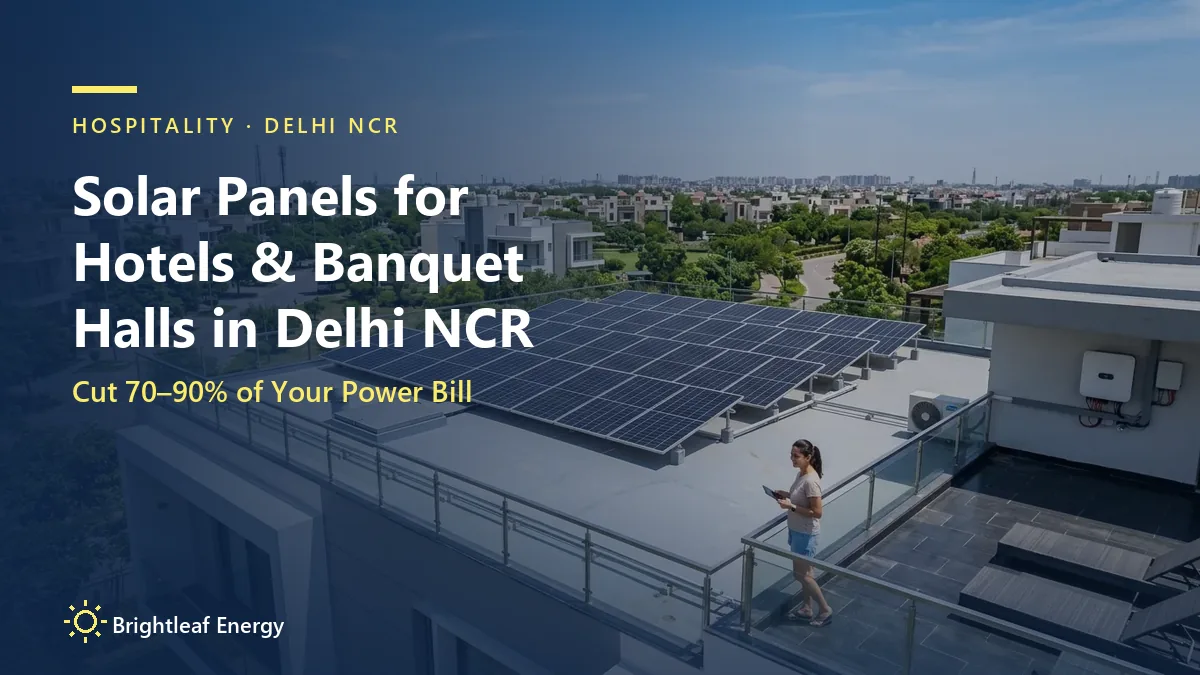
Hotels are among the strongest commercial solar economics in Delhi NCR. The reason is simple: a hotel’s load runs 24 hours a day \u2014 kitchen, laundry, lifts, pumps, cold rooms, and daytime HVAC \u2014 while commercial tariffs sit in the \u20b98\u201311 per unit range. A 100\u2013250 kW rooftop system typically offsets 70%\u201390% of a hotel’s daytime consumption, with payback in the region of 3\u20134 years.
Banquet halls and event venues work on the same logic, with one twist: their peak demand is event-driven, so surplus generation on quiet weekdays becomes valuable banked credit rather than waste. Brightleaf Energy designs and builds these systems for hospitality properties across NCR \u2014 see how we handle commercial solar for hotels in Delhi and the wider portfolio on our commercial solar solutions page.
Last updated: October 2026. Worked examples are illustrative planning models for Delhi NCR hotels, not quotations or guaranteed results. Actual savings depend on occupancy, load profile, tariff slab, shading and system design.
Hotels and banquet venues in Delhi NCR typically recover capital in 3\u20134 years because the load runs through the solar window almost every hour of the year. Claim 40% accelerated depreciation under Section 32 in Year 1 to bring the effective net outlay down 20%\u201330%. Figures in this guide are indicative 2026 planning ranges, not quotations.
Why Hotels Are An Ideal Solar Customer
| Load | Operating pattern | Solar overlap |
|---|---|---|
| Kitchen and banqueting (cooking, induction, extraction) | Morning and evening peaks | Strong |
| Central laundry | Daytime | Strong |
| Room HVAC, geyser, room units | 24×7, daytime-weighted | Strong |
| Lifts, water pumps, treatment plant | Daytime | Strong |
| Cold rooms and bar refrigeration | 24×7 | Strong |
| Banquet halls — lighting, AV, HVAC, catering | Evening and event-driven | Partial — net metering covers the gap |
| Pool, landscape, common areas | Daytime | Good |
Two characteristics make hotels unusual among commercial consumers. First, the load never sleeps, so self-consumption stays high even in shoulder-season months. Second, tariffs are high, because hospitality loads sit in commercial slabs with demand charges.
Sizing Solar For A Hotel: A Representative Model
Consider a 150-room hotel property in Delhi NCR with typical consumption of roughly 50,000\u201370,000 units a month (7\u20139 lakh units a year) and a main building with adequate flat-roof and terrace area.
| System size | Indicative cost | Roof area | Monthly generation | Annual savings at ₹9/unit | Payback |
|---|---|---|---|---|---|
| 100 kW | ₹38 L – ₹48 L | ~8,000 sq. ft. | ~12,500 units | ~₹13.5 L | ~2.9 – 3.6 yrs |
| 150 kW | ₹57 L – ₹72 L | ~12,000 sq. ft. | ~18,750 units | ~₹20.25 L | ~2.9 – 3.6 yrs |
| 250 kW | ₹92.5 L – ₹1.20 Cr | ~20,000 sq. ft. | ~31,250 units | ~₹33.75 L | ~2.7 – 3.6 yrs |
| 500 kW | ₹1.80 Cr – ₹2.40 Cr | ~40,000 sq. ft. | ~62,500 units | ~₹67.5 L | ~2.7 – 3.6 yrs |
For a hotel with 7\u20139 lakh units of annual consumption, a 150\u2013250 kW system is usually the sweet spot: it covers the daytime base load almost entirely, leaves the night load on the grid, and returns the best value per square foot of usable roof. Oversizing beyond the self-consumption point earns less per rupee because the surplus is credited at export rates rather than retail. Roof planning follows the site norm of roughly 80 sq. ft. of usable, shadow-free area per kW.
The Bill-Reduction Maths
| Tariff | Annual bill avoided (250 kW system) | Reduction vs a typical hotel bill |
|---|---|---|
| ₹8.00/unit | ~₹25.2 L | ~55%–65% |
| ₹9.00/unit | ~₹28.3 L | ~60%–75% |
| ₹10.50/unit | ~₹33.0 L | ~70%–90% |
Note on estimates: The reduction percentage depends on how much of your consumption happens during the solar window. A hotel running 24\u00d77 loads captures a larger share of generation on site than an office that empties at 6 pm. These figures assume 1,500 units per kW per year, minimal shading and full net-metering credit settlement.
Banquet Halls And Event Venues
Banquet and event operations have a distinctive load curve: quiet weekday mornings, heavy evening function loads, and weekend peaks. Three consequences follow:
Size to the annual base load, not to the biggest event. Sized to peak banquet demand, most of the year sits heavily over-exported; sized too small, weekday generation still earns through credits, but you leave retail-offset savings on the table.
Net metering is what makes event venues work. Exported units from a quiet Tuesday are credited back when the ballroom is full on Saturday. A four-quadrant bi-directional TOD meter records both flows and credits roll forward through the financial year.
Carport and canopy options. Where roof area is limited, ground-mounted solar carports over the parking area are an option NCR properties use frequently — they generate during peak daytime hours and shade parked vehicles in return.
For the regulatory detail behind export credits and DISCOM approval handling, see our commercial solar solutions page, which sets out the net metering and approval flow across Delhi NCR DISCOMs.
Tax Position For Hotels
No capital subsidy
Central schemes such as PM Surya Ghar are restricted to residential consumers. Hotels and hospitality businesses claim benefits through tax, not subsidy.
40% Year-1 depreciation (Section 32)
For a profitable hotel company or a leasing entity, this is the single largest financial lever — it typically recovers 10%–12% of project cost in direct tax savings in Year 1, and with GST planning can reduce the effective net outlay by 20%–30%.
GST treatment
Modules fall under the 5% renewable energy entry while other components differ, and turnkey EPC agreements use a 70:30 goods-and-services valuation. Your CA should verify the treatment — our solar tax benefits guide covers it in detail.
Leased properties
If your hotel is on lease, a RESCO structure delivers a 20%–40% discount on tariff with zero capital outlay — an investor owns and maintains the plant while you buy the power.
For the full depreciation, ITC and HSN breakdown, see our solar tax benefits in India guide, and for the CAPEX-versus-RESCO decision on leased or investor-owned properties, our commercial solar ROI guide compares both models sector by sector.
Operating A Hotel Through A Solar Installation
Hospitality projects have a constraint most commercial installations do not: you cannot shut the building. Practical requirements:
- Phased installation. Roof zones are installed and commissioned in sequence, with panels and equipment routed away from guest circulation.
- Work windows. Drilling, structural work and cable routing scheduled outside check-in, check-out and function hours.
- Guest experience is unaffected. Solar PV is silent, has no moving parts and introduces no combustion risk. There is no perceptible change for guests.
- Structural checks are stricter. Older hotel buildings, especially pre-2000 properties, need a structural load audit before any array is mounted \u2014 roof slabs, beams and water-tank platforms all need verification.
- Fire safety. DC cabling is routed in fire-rated pathways away from escape routes, with string-level protection, earthing and surge protection designed for an occupied building.
- Aesthetics. Arrays are placed on rear and terrace zones out of sightlines from guest rooms and street-facing elevations wherever the roof allows.
DG Backup, GRAP And Diesel Displacement
Hotels in Gurugram and across NCR face winter GRAP restrictions on diesel generator use, and many properties run gensets for evening functions regardless. Synchronising the solar plant with the DG set through zero-export controllers and synchronising relays lets the inverters pick up load when the grid fails, typically supplying up to about 70% of the active load while maintaining a reverse-power safety buffer \u2014 cutting diesel consumption by an estimated 60%\u201370%.
Our commercial solar team in Gurugram handles DG-PV synchronisation and fuel-savings engineering as part of the electrical scope.
ESG Reporting For Hotel Groups
A rooftop solar system reduces Scope 2 emissions by roughly 1.2 tonnes of CO\u2082 per kW per year, with no Scope 3 accounting complexity. For hotel groups and corporate operators, that figure feeds directly into BRSR, IGBC and LEED documentation \u2014 a documented, auditable reduction rather than an offset purchase. For hotels inside NCR’s hospitality corridors, we also see solar paired with EV charging for staff and guest fleets.
ESG math for a 250 kW hotel array: roughly 300 tonnes of CO\u2082 avoided per year \u2014 an auditable Scope 2 reduction that lands in BRSR and IGBC/LEED submissions without offset purchases.
How To Choose A Solar EPC For A Hotel
Hospitality references. Ask for comparable hotel or hospitality installations, not just industrial roofs — the operational constraints are different.
Occupied-site plan. The contractor should present a phased, work-windowed execution plan before you sign.
Aesthetic review. Roof layout drawings showing sightlines, parapet set-back and terrace use, so the property still looks like a hotel.
Electrical scope clarity. LT/HT integration, protection coordination, DG synchronisation requirements and earthing design stated explicitly.
Approval handling. Net metering filing and CEIG clearances managed by the EPC, with timelines in the contract.
O&M with a hospitality SLA. NCR dust and particulate can degrade output by 15–25% without disciplined cleaning — confirm response times and cleaning frequency in the AMC.
Hotels & resorts
24×7 kitchen, laundry and room loads give the fastest self-consumption in NCR — typically 70%–90% offset.
Banquet halls & venues
Net metering banks weekday generation against evening and weekend event peaks.
DG-heavy properties
Zero-export DG-PV synchronisation cuts diesel run-hours and eases GRAP compliance.
Frequently Asked Questions (FAQs)
How much can a hotel save on electricity bills with solar?
A 250 kW system in NCR offsets roughly ₹25–33 lakh a year at tariffs of ₹8–11 per unit, cutting 60%–90% of a typical hotel's bill depending on how much consumption falls in the solar window. Hotels with 24×7 loads capture the most.
How much solar does a 100-room hotel need?
Typically 100–150 kW — around 8,000–12,000 sq. ft. of usable roof at 80 sq. ft. per kW. The exact size depends on annual consumption, room count, laundry and kitchen loads, and roof area.
Can hotels install solar on terrace and canopy areas?
Yes. Hotels routinely combine main-roof arrays with terrace sections and ground-mounted solar carports over parking, which is often the fastest way to add capacity without touching the guest-facing facade.
Is there any subsidy for hotels installing solar?
No. Central subsidy schemes such as PM Surya Ghar are residential-only. Hospitality businesses benefit through 40% Year-1 depreciation under Section 32, GST planning where eligible, and immediate operating-cost reduction.
Will solar work if our hotel is on lease?
Yes. A RESCO/OPEX structure lets an investor own and maintain the plant on your roof while you buy power at a tariff typically 20%–40% below your DISCOM rate with zero capital outlay.
How does solar help during power cuts or GRAP restrictions?
With DG-PV synchronisation, solar keeps supplying load when the grid fails and the genset runs, displacing a large share of diesel generation. That both cuts fuel cost and helps with winter GRAP compliance in Gurugram and other NCR districts.
How long does a hotel solar project take?
Typically 8–12 weeks from survey to commissioning, extended for larger or phased installations in occupied properties. Work is sequenced around guest operations, so scheduling matters as much as construction.
Sources & Official References
- Ministry of New and Renewable Energy (MNRE)
- Delhi Electricity Regulatory Commission (DERC)
- BSES Delhi (Rajdhani & Yamuna Power)
- Haryana Electricity Regulatory Commission (HERC)
- Uttar Pradesh Electricity Regulatory Commission (UPERC)
Tariffs, subsidy rules, GST treatment, GRAP norms and tax positions are subject to change and to site/DISCOM approval. Verify against the official portals above and with your chartered accountant before relying on any figure.