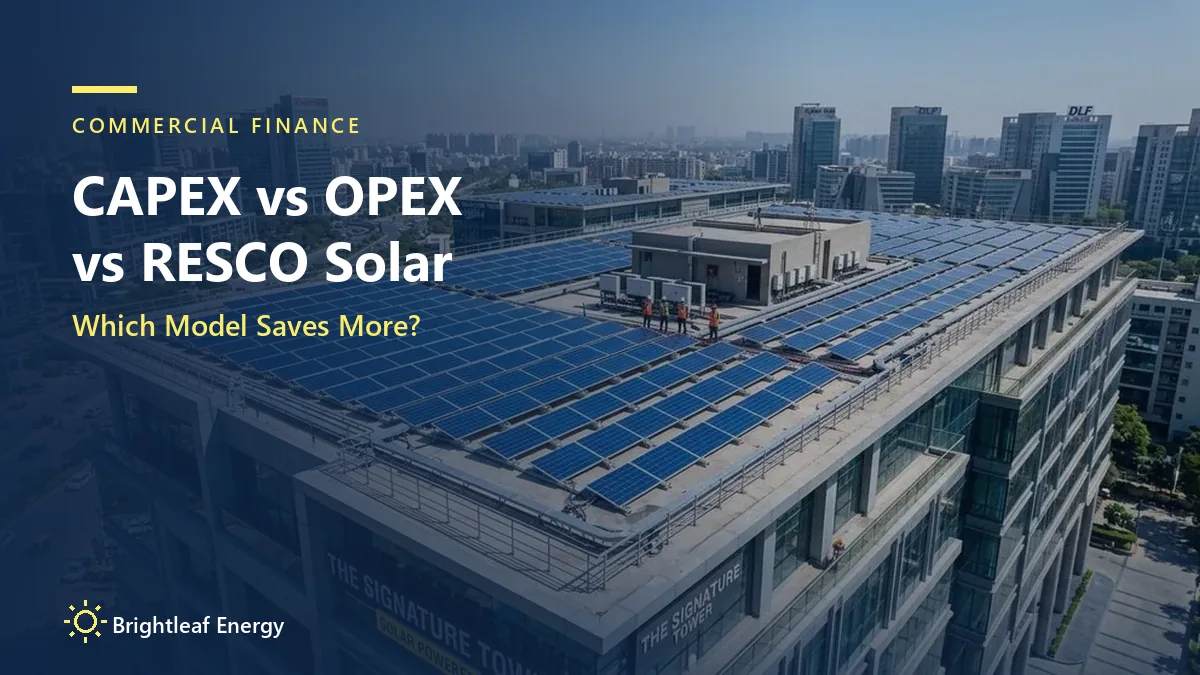
The short answer: CAPEX saves the most over a system’s life, and OPEX/RESCO saves you the most immediately and with the least risk. A business that is profitable, has the capital and intends to stay in the same building should normally buy the system outright — 40% Year-1 depreciation plus bulk pricing makes ownership the cheapest source of power over 20+ years. A tenant, a capital-constrained firm, or a business facing relocation risk should take the zero-capex route and pay a few paise more per unit for certainty.
Brightleaf Energy structures both through flexible commercial financing — CAPEX and OPEX/PPA — so the honest way to choose is to compare the three models on the same numbers.
Last updated: October 2026. Worked examples use a 100 kW system, a ₹9/unit commercial tariff and ~1,500 units per kW per year in Delhi NCR. Figures are illustrative planning ranges, not quotations or offers.
rooftop solar vs traditional electricity 10-year ROI, solar panels for business ROI, solar panels for hotels and banquet halls and solar blogs and guides.
The model decision is a balance-sheet decision, not an engineering one. The plant is identical in all three cases — what changes is who funds it, who claims the 40% depreciation, and who carries the performance and maintenance risk for the next 20–25 years.
The Three Models, Defined
CAPEX (direct ownership)
Your business buys the plant — modules, inverters, structure, cabling, approvals and installation — and owns it outright. You keep every unit generated, claim 40% accelerated depreciation in Year 1 under Section 32 of the Income Tax Act, and carry the maintenance responsibility. Typical commercial payback in NCR: 3–4 years.
OPEX / PPA (third-party ownership)
An investor funds, builds, owns and maintains the system on your roof. You sign a power purchase agreement — commonly 20–25 years — and buy the solar electricity it generates at a tariff typically 20%–40% below your DISCOM rate. Your upfront investment is zero, and so is your maintenance risk.
RESCO (Renewable Energy Service Company)
Structurally a third-party-ownership model where the service company owns the plant, services it, and often arranges the capital. You host the plant, pay for the power at the contracted tariff, and the RESCO/investor claims the depreciation and other tax benefits. This is the standard route for tenants and for companies that want the bill reduction without touching the balance sheet.
CAPEX vs OPEX vs RESCO: Side-By-Side Comparison
| Parameter | CAPEX | OPEX / PPA | RESCO |
|---|---|---|---|
| Upfront investment | Full project cost | Zero | Zero |
| Who owns the plant | Your business | Investor | RESCO / investor |
| Who maintains it | You, or under an AMC | Investor | RESCO |
| Who claims 40% depreciation (Section 32) | Your business | Investor | RESCO / investor |
| GST input tax credit | Subject to your GST conditions | Claimed by investor | Claimed by RESCO |
| Effective power cost | Lowest — roughly ₹2.20–3.00 per unit over time | Contracted tariff, typically 20%–40% below DISCOM | Similar to OPEX |
| Immediate bill reduction | ~70%–90% of the generation value | ~20%–40% of the bill from day one | ~20%–40% from day one |
| Typical payback | 3–4 years in NCR | Not applicable — savings are immediate | Not applicable |
| Cash flow | Outflow upfront, return from Year 1 | Monthly/quarterly PPA payments | Monthly/quarterly payments |
| Balance-sheet impact | Asset on books | Off-balance-sheet | Off-balance-sheet |
| Contract length | None (one-time purchase) | Usually 20–25 years | Usually 20–25 years |
| Exit / relocation | Sell or relocate the asset | Buy-out or transfer terms apply | Buy-out or transfer terms apply |
| Best fit | Profitable owners, long-tenure buildings | Capital-constrained firms, 24×7 load owners | Tenants, undecided tenures, faster approvals |
Worked Example: 100 kW In Delhi NCR
| Line | CAPEX | OPEX / PPA |
|---|---|---|
| Upfront investment | ₹41.0 lakh | ₹0 |
| Contracted/own power cost | ~₹2.20–3.00 per unit effective | ₹5.50–6.50 per unit |
| Year-1 gross bill avoided | ~₹13.5 lakh | ~₹4.7 lakh (at ₹6.00/unit PPA) |
| Year-1 tax shield (40% depreciation, if taxable) | ~₹4.1–4.9 lakh | Claimed by the investor |
| Year-1 net cash benefit | ~₹17.6–18.4 lakh | ~₹4.7 lakh |
| Time to recover upfront cost | ~2.3 years on cash flow; ~3.0 years simple payback | Not applicable |
| 25-year gross bill avoided (before O&M and degradation) | ~₹33.75 crore | ~₹11.25 crore |
The gap is the price of the capital and the risk transfer. The OPEX investor prices in a required return and gives you a discount that still leaves them profitable over 20–25 years. Roughly 60% of the lifetime savings is what you are exchanging for zero upfront spend — which is an excellent trade for a tenant or a business that might move in five years, and a poor trade for an owner who will stay for a decade or more.
For the underlying equipment and installation costs, see our 100 kW solar system price guide and the commercial solar cost per kW in India.
When CAPEX Wins
You own the building and expect to hold it for 8+ years.
The business is profitable and can use depreciation against taxable income.
Your daytime load matches generation closely, so self-consumption is high.
You want the asset on the balance sheet (valuable at resale, in audits, and in ESG reporting).
You want control over maintenance standards, cleaning frequency and upgrade timing.
When OPEX Or RESCO Wins
You lease the property, or your tenure is uncertain.
Capital is committed elsewhere and a 3–4 year payback window is a problem, not a feature.
You want a predictable monthly saving without managing EPC contracts or AMC vendors.
Your facility is relatively small in scale and the fixed costs of ownership would eat the benefit.
You are consolidating multiple sites and want a single energy partner rather than multiple projects.
The Hybrid Approach
Many NCR businesses land on a hybrid: CAPEX for the core load, OPEX for the balance. Buy the portion of the system that matches your steady daytime consumption (the part with the best self-consumption and the strongest depreciation claim), then take an OPEX/PPA structure for the surplus roof area or the Phase-2 expansion. This keeps the tax shield where it is most valuable and the capital where it is least needed.
Sizing note: a hybrid works best when the CAPEX portion is sized to your daytime base load and the OPEX portion covers surplus roof. Splitting one metering point casually between two owners is where disputes start — document metering, access and roof rights as a single coordinated project.
The Tax Angle: Who Gets What
Under Section 32 of the Income Tax Act, the owner of an eligible solar asset claims the 40% Year-1 depreciation. In an OPEX/RESCO structure, that asset sits with the investor — which is precisely how they fund the project and why they can offer you a discount.
40% is a deduction, not a refund
It reduces taxable income; the cash benefit equals the deduction multiplied by your effective tax rate. Our solar tax benefits guide covers depreciation, GST input tax credit, HSN codes and the Income Tax Act, 2025 transition in full.
Depreciation and ITC are planned together
Where depreciation is claimed on the GST component of capital goods, ITC on that same GST component is restricted — so the structure of your solar invoice affects your credit.
Read the full mechanics in our solar tax benefits in India guide, and confirm your position with your CA before choosing the ownership structure.
What To Negotiate In An OPEX/PPA Agreement
Before signing any PPA, get explicit written answers on:
Tariff and escalation. The opening tariff, annual escalation cap, and what happens if your DISCOM tariff falls.
Generation guarantee. Is there a minimum guaranteed output, and what are the remedies if the plant underperforms?
Maintenance responsibility. Who cleans, who repairs, who replaces inverters, and at whose cost — including the inverter replacement typically due around year 10–12.
Roof and access rights. Can the investor access the roof for maintenance without your approval? What if they damage the roof — who repairs?
Net metering and credits. Whose name is the net meter in? Who receives the export credits, and does that change over the contract?
Term and exit. Contract length, lock-in period, buy-out schedule, and what happens to the plant if you sell the building or wind down the business.
Insurance and liability. Who insures the plant, and who carries liability for grid events, fire or storm damage.
Five Red Flags In “Zero Down Payment” Solar Offers
No generation guarantee — you pay for units regardless of how many are actually produced.
Escalation of 8%–10% per year with no cap — the “discount” erodes within a decade.
Vague roof rights — vague in your favour or theirs; either way it becomes a dispute at exit.
PPA priced per unit consumed, not generated — you can be billed for units you never used.
The investor claims depreciation, GST credit and passes you a tariff above your DISCOM rate — there is no deal here.
How To Choose: A Simple Decision Framework
| Your situation | Best fit |
|---|---|
| Owner, profitable, 8+ year horizon | CAPEX |
| Owner, profitable, capital committed elsewhere | CAPEX with a green term loan |
| Tenant, or tenure under 5 years | OPEX / RESCO |
| Multi-site rollout, want one partner | OPEX / RESCO |
| 24×7 load owner (hotel, hospital, cold storage) | CAPEX, sized to self-consumption |
| MSME needing month-1 cash-flow positivity | OPEX, or green loan CAPEX if EMIs sit below savings |
Frequently Asked Questions (FAQs)
Which model saves more money for a business?
CAPEX saves the most over the system's life because you keep 100% of the generation value and the tax benefits. OPEX and RESCO save money immediately — typically 20%–40% off your bill from day one — without any capital outlay. On a 100 kW NCR example, CAPEX is worth roughly 2.5–3× the lifetime savings of a PPA.
Is zero down payment commercial solar real?
Yes. It is a standard OPEX/PPA or RESCO structure where a third party funds, owns and maintains the plant, and you buy the power at a discounted tariff. It is genuine — but the discount is paid for out of lifetime savings, and contract terms decide whether the deal is good.
Can I buy the system later under an OPEX agreement?
Often yes. Many PPAs include a buy-out schedule at a pre-agreed price. Ask for the buy-out table before signing — a system you can purchase in year 6 at a defined multiple turns OPEX into a bridge rather than a 25-year commitment.
Who claims the 40% accelerated depreciation?
The owner of the asset. Under CAPEX, that is you. Under OPEX and RESCO, the depreciation and GST benefits belong to the investor — which is how they justify the discount they pass on to you.
Is RESCO different from OPEX?
RESCO is a common name for the third-party rooftop energy service model — a variant of OPEX where the service company owns, operates and usually finances the plant, and the host buys the power. The commercial effect is similar; the naming and the contracting structure differ.
Can I mix CAPEX and OPEX on the same site?
Yes, and many businesses do. Own the portion of the array that matches your core daytime load, and take an OPEX/PPA structure for surplus roof area or later expansion. Ensure the metering, access and roof arrangements are documented as a single coordinated project.
How do I know an OPEX tariff is fair?
Compare it to your current DISCOM rate and to what you would pay under CAPEX. A fair PPA tariff sits roughly 20%–40% below your grid rate, with a capped escalation and a generation guarantee. If the quoted tariff is only 5% below grid, the PPA is not doing much for you.
Sources & Official References
- Ministry of New and Renewable Energy (MNRE)
- Income Tax Department — depreciation rules
- Delhi Electricity Regulatory Commission (DERC)
- Haryana Electricity Regulatory Commission (HERC)
- Uttar Pradesh Electricity Regulatory Commission (UPERC)
Financing terms, tax treatment and DISCOM tariffs are subject to change and to contract. Verify against the official portals above and with your chartered accountant before relying on any figure.