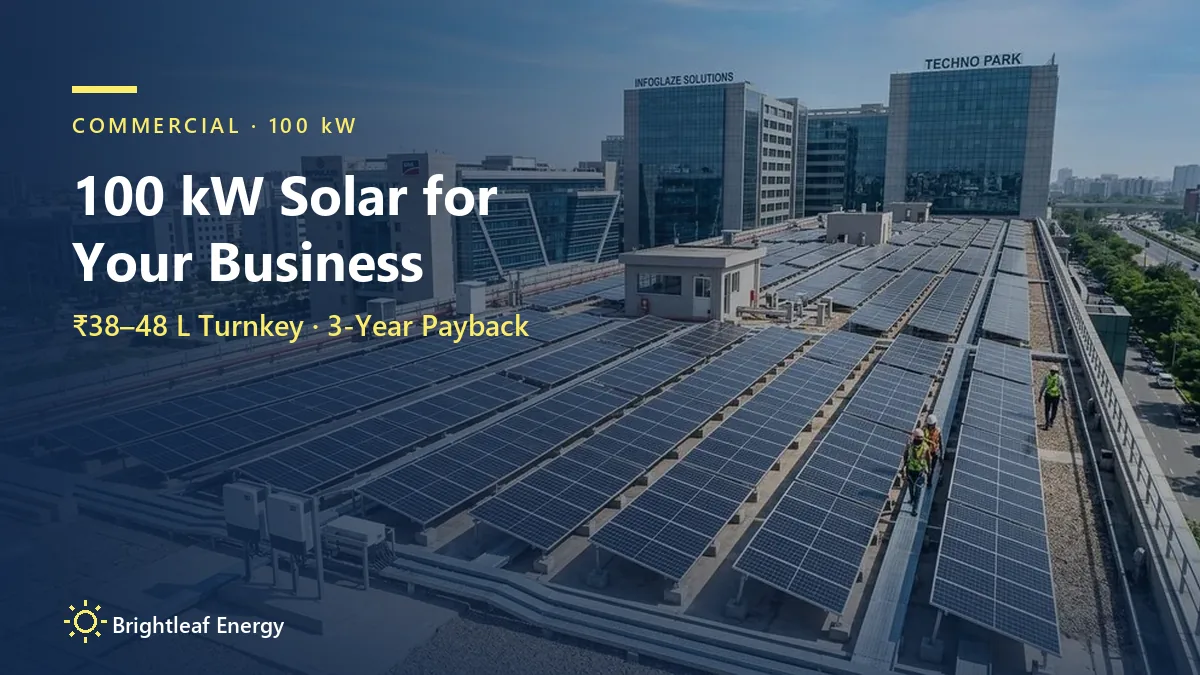
A 100 kW commercial solar system costs ₹38–48 lakh turnkey in India in 2026, which works out to roughly ₹38,000–48,000 per kW. In Delhi NCR, a well-engineered 100 kW plant generates about 12,500 units a month (~1.5 lakh units a year), worth around ₹13.5 lakh a year at a ₹9/unit commercial tariff — before any tax benefit. After the 40% Year-1 depreciation shield, most 100 kW projects in NCR recover capital in roughly 3–3.5 years.
100 kW is the sweet spot for a mid-size business: big enough for bulk pricing on modules, inverters and structure, small enough for a single LT or HT connection and one clean approval cycle. If your site matches that profile, Brightleaf Energy delivers 100 kW-class turnkey solar EPC in Noida and across NCR industrial belts.
Last updated: October 2026. Figures are indicative Delhi NCR planning ranges, not quotations. Generation assumes ~1,500 units per kW per year; savings depend on your actual tariff, load profile and shading.
3kW, 5kW and 10kW solar system cost guide, 5kW solar panel price in India, solar power cost for home in India and solar blogs and guides.
A 100 kW plant is the most commonly mis-quoted size in NCR because it sits just under the CEIG threshold. Confirm the proposal states module count, wattage, string configuration and inverter sizing — without those, you are comparing an abstraction with a design, and the abstraction always looks cheaper.
What Is The 100 kW Solar System Price Today?
| Reference system | Value |
|---|---|
| Capacity | 100 kWp on-grid (rooftop) |
| Indicative turnkey cost | ₹38.0 L – ₹48.0 L |
| Price per kW | ₹38,000 – ₹48,000 |
| Usable roof area required | ~8,000 sq. ft. (80 sq. ft. per kW) |
| Monthly generation | ~12,500 units (NCR, typical month) |
| Annual generation | ~1.5 lakh units |
| Annual savings at ₹9/unit | ~₹13.5 lakh |
| Simple payback | ~2.9 – 3.6 years |
| Effective outlay after Year-1 tax shield | Typically 20%–30% below headline cost |
Note on estimates: NCR commercial generation is generally calculated at 4.2–4.5 peak sun hours per day. Real output depends on orientation, shading, soiling, module temperature and system uptime.
Where The ₹38–48 Lakh Goes
Taking a ₹41 lakh reference system as an example:
| Component | Share | Indicative cost |
|---|---|---|
| Solar modules (bifacial TOPCon / equivalent Tier-1 ALMM) | ~45% | ₹18.4 L |
| Inverters (string architecture) | ~10% | ₹4.1 L |
| Mounting structure (galvanised, wind-engineered) | ~10% | ₹4.1 L |
| Balance of system — DC/AC cables, LT panel, earthing, SPDs | ~15% | ₹6.2 L |
| Civil works, structure, installation | ~12% | ₹4.9 L |
| Design, approvals and project management | ~5% | ₹2.1 L |
| Net metering and commissioning | ~3% | ₹1.2 L |
This split is the fastest way to compare two quotes. If one bidder’s “modules” line is 15% below everyone else’s, ask whether the shortfall has been pushed into inferior structure, thinner cable, or an omitted approval scope.
How Much Electricity Does A 100 kW System Generate?
Monthly generation in NCR follows the irradiance curve — strong from October to April, softer through the monsoon:
| Month | Approx. generation |
|---|---|
| January | ~10,500 units |
| February | ~11,800 units |
| March | ~14,200 units |
| April | ~15,300 units |
| May | ~15,000 units |
| June | ~13,200 units |
| July | ~11,500 units |
| August | ~10,800 units |
| September | ~12,000 units |
| October | ~13,800 units |
| November | ~12,500 units |
| December | ~10,700 units |
| Year | ~1,51,000 units |
A 100 kW system self-consumes the large majority of this output in businesses with daytime loads — factories on day shifts, warehouses with material-handling and lighting loads, hotels with kitchen, laundry and daytime HVAC, and schools and clinics that operate through the day. Where consumption dips at weekends, net metering is what converts the surplus into bill credit instead of wasted generation — see our commercial net metering guide for Delhi NCR.
What 100 kW Looks Like On The Roof
A 100 kW commercial system is a defined physical object, not an abstract number. For planning purposes:
| Component | Typical configuration for a 100 kWp plant |
|---|---|
| Solar modules | ~180–190 bifacial TOPCon modules of 550 Wp each |
| Module surface area | ~470–500 sq. m. of panel surface |
| Usable roof area required | ~740 sq. m. (~8,000 sq. ft.) after row spacing, walkways and setbacks |
| Row layout | 8–12 rows, typically 24–26 modules per string |
| Inverters | 8–10 × 10 kW string inverters, or 1–2 × 50–100 kW central units |
| DC side | String cables, DC combiner/SPD, DC isolators per the approved SLD |
| AC side | LT or HT panel integration, protection relays, earthing pits, surge protection |
| Access | Inter-row walkways for cleaning and inspection over the system's life |
If a proposal does not specify module count, wattage, string configuration and inverter sizing, you are comparing an abstraction with a design — and the abstraction will always look cheaper.
Payback And ROI At Different Tariffs
| Commercial tariff | Annual bill avoided (gross) | Payback on ₹41 L | Payback after Year-1 tax shield |
|---|---|---|---|
| ₹8.00/unit | ~₹12.1 L | ~3.4 yrs | ~2.5 yrs |
| ₹9.00/unit | ~₹13.5 L | ~3.0 yrs | ~2.3 yrs |
| ₹10.50/unit | ~₹15.9 L | ~2.6 yrs | ~2.1 yrs |
Simple payback = project cost ÷ annual bill avoided, before deducting O&M. Real cash payback is typically 0.2–0.4 years longer once preventive maintenance, insurance and any inverter replacement reserve are accounted for.
Across NCR, commercial solar projects typically deliver an internal rate of return in the 22%–35% range, depending on tariff, capacity factor and utilisation of the generation. For sector-specific payback models, see our commercial solar ROI guide.
The Year-1 Tax Shield Changes The Cash Flow
Under Section 32 of the Income Tax Act, an eligible 100 kW solar asset attracts 40% depreciation in the first financial year:
| Line item | Amount |
|---|---|
| Project cost | ₹41.00 L |
| Year-1 depreciation at 40% | ₹16.40 L deduction |
| Direct tax saved (at 25%–30% effective rate) | ~₹4.1 L – ₹4.9 L |
| GST input tax credit | Eligible in principle, subject to GST conditions and asset-cost treatment |
| Effective net outlay | Typically ~₹29 L – ₹33 L |
100 kW Under CAPEX vs Under OPEX/PPA
If capital is the constraint, the same 100 kW output can be delivered without any capex:
| Model | Upfront cost | Year-1 annual saving | Who owns the plant | Depreciation claimed by |
|---|---|---|---|---|
| CAPEX (direct purchase) | ₹38 L – ₹48 L | ~₹13.5 L at ₹9/unit tariff (100% of generation) | Your business | Your business (40% Section 32) |
| OPEX / PPA | ₹0 | ~₹4 L – ₹5 L (tariff typically 20%–40% below DISCOM rates) | Third-party investor | The investor, under its own structure |
CAPEX maximises lifetime savings and keeps the asset on your balance sheet. OPEX trades a portion of that lifetime value for zero capital outlay, no maintenance risk and an immediate bill reduction from month one. Our CAPEX vs OPEX vs RESCO guide walks through the full comparison, and our commercial solar solutions page covers both financing routes plus green loan options such as SIDBI and SBI Surya Shakti.
What Raises Or Lowers The 100 kW Quote
Roof type
RCC slab is cheapest. PEB or trapezoidal metal sheds need non-penetrating standing-seam clamps or EPDM-gasketed fixtures with double sealant layers, which cost more but protect the roof warranty.
Interconnection voltage
Plants above 50 kW are typically connected at 11 kV or 33 kV with dual-protection relays, adding switchgear and liaison scope.
CEIG clearances
Electrical drawing approval and inspection from the Chief Electrical Inspector are required for systems exceeding 100 kW, and for HT-connected plants at any capacity — including a 100 kW project on an HT supply.
Cable distance
A roof far from the LT panel room or transformer adds cost and voltage drop.
Site conditions
Crane access, material movement, night-shift work windows and live-plant safety protocols all carry a cost.
Generation target
Sophisticated string design, higher module efficiency or elevated walkways add cost but improve yield and longevity.
Is 100 kW The Right Size For Your Business?
100 kW is a good fit if you are:
- A manufacturing unit or auto ancillary running a day shift
- A warehouse or logistics hub with lighting and material-handling loads
- A hotel or banquet property with 24×7 consumption
- A cold storage or food-processing plant
- A school, hospital or institutional campus
- A retail mall or commercial complex with common-area HVAC and lighting
It also fits the regulatory limit comfortably: Haryana’s net metering framework for commercial consumers runs to 100% of sanctioned load with a 500 kW regulatory cap, so a 100 kW plant sits well inside the net-metered band. Faridabad’s fabrication and automotive units, for example, run at this scale routinely — see our commercial solar solutions in Faridabad page for DHBVN interconnection details at HT voltage.
Roof check first: a 100 kW array needs roughly 8,000 sq. ft. of usable, shadow-free roof. If your roof is smaller, the sanctioned load is the other ceiling — size to whichever binds first.
How To Validate A 100 kW Quotation
Confirm the design is sized to your load and roof, not to a round number.
Ask for module make, model and wattage, plus inverter make and model.
Verify the structure is specified for your roof type and local wind conditions.
Check the approval plan: net metering filing, CEIG drawings, who does each, and what happens on delay.
Confirm the commissioning deliverables — performance test report, synchronisation certificate, warranty documents.
Model your own cash flow: cost, Year-1 depreciation shield, annual savings at your real tariff, O&M.
Frequently Asked Questions (FAQs)
How much does a 100 kW solar system cost in India?
A 100 kW turnkey on-grid commercial system typically costs ₹38–48 lakh in 2026 (₹38,000–₹48,000 per kW). Roof type, module technology, interconnection voltage and EPC scope move the final number.
How many units does a 100 kW solar system generate per month?
About 12,500 units in a typical NCR month, roughly 1.5 lakh units a year, based on 4.2–4.5 peak sun hours per day. Summer and pre-monsoon months produce more; monsoon months less.
How much will a 100 kW system save on electricity bills?
At a ₹9/unit commercial tariff, roughly ₹13.5 lakh a year. At ₹8/unit, about ₹12.1 lakh; at ₹10.50/unit, about ₹15.9 lakh. Net metering ensures surplus daytime generation is credited rather than wasted.
How much roof space is required for 100 kW?
Roughly 8,000 sq. ft. of usable, shadow-free roof at 80 sq. ft. per kW, plus walkways, setbacks and module spacing. Older roofs and constrained layouts may need a slightly higher area per kW.
Can I get a 100 kW system financed without paying upfront?
Yes. Under OPEX/PPA and RESCO structures, a third party funds, owns and maintains the plant and you buy the power at a tariff typically 20%–40% below your DISCOM rate with zero capital outlay. Green term loans are another route for MSME-scale buyers.
Is a 100 kW commercial system eligible for subsidy?
No. Central subsidy schemes such as PM Surya Ghar are residential-only. Businesses instead benefit from 40% Year-1 depreciation under Section 32, potential additional depreciation, GST input tax credit where eligible, and immediate operating-cost reduction.
How long does it take to commission a 100 kW plant?
Typically 8–12 weeks from site survey to grid commissioning — design and approvals run 4–8 weeks depending on DISCOM and CEIG processes, with 2–6 weeks for installation. Complete documentation is the main factor that shortens or delays the timeline.
Sources & Official References
- Ministry of New and Renewable Energy (MNRE)
- Income Tax Department — depreciation rules
- CBIC — GST rates and classification
- Haryana Electricity Regulatory Commission (HERC)
- DHBVN — solar net metering portal
Prices, depreciation rates, GST treatment and DISCOM caps are subject to change and to site approval. Verify against the official portals above and with your chartered accountant before relying on any figure.