If you are researching Solar Power For Home Cost in India, the actual investment depends on your electricity consumption, required system capacity, solar panel and inverter specifications, roof condition, installation complexity, and applicable government subsidy.
Brightleaf Energy currently lists residential solar installations within a broad range of ₹50,000 to ₹6,00,000. The final price depends on the specific requirements of your property.
The Solar Power For Home Cost is not a fixed amount for every household. Eligible residential consumers can receive up to ₹78,000 in central subsidy under PM Surya Ghar, while the remaining investment depends on the system capacity, equipment, roof and installation requirements.
In this blog, we will provide a personalised solar assessment that provides a more reliable estimate than a generic ₹/kW price.
3kW, 5kW and 10kW solar system cost guide, 1kW vs 3kW vs 5kW solar system comparison, 5kW solar panel price in India and solar blogs and guides.
How Much Does Solar Power For A Home Cost In 2026?
The Solar Power For Home Cost depends mainly on the size and configuration of the system. A complete residential solar installation can include solar panels, an inverter, mounting structure, electrical protection equipment, wiring, installation, commissioning and assistance with applicable approvals.
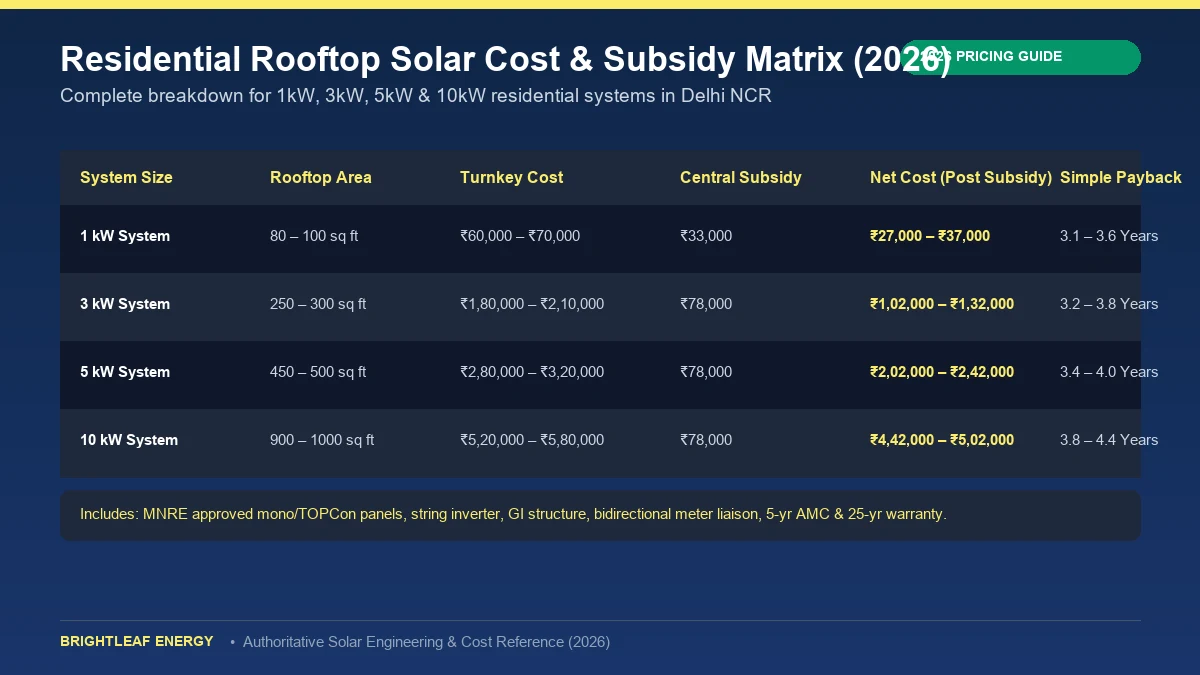
In 2026, residential on-grid solar installation costs in India typically range from ₹60,000 for 1kW up to ₹6,50,000 for 10kW before central and state subsidies. Here is the quick-answer 2026 pricing and PM Surya Ghar subsidy comparison across standard home capacities:
| System Size | Pre-Subsidy Cost (2026) | PM Surya Ghar Subsidy | Net Cost After Subsidy | Monthly Units |
|---|---|---|---|---|
| 1 kW On-Grid | ₹60,000 – ₹75,000 | ₹30,000 | ₹30,000 – ₹45,000 | 120 – 150 Units |
| 2 kW On-Grid | ₹1,25,000 – ₹1,50,000 | ₹60,000 | ₹65,000 – ₹90,000 | 240 – 300 Units |
| 3 kW On-Grid | ₹1,80,000 – ₹2,10,000 | ₹78,000 | ₹1,02,000 – ₹1,32,000 | 360 – 450 Units |
| 5 kW On-Grid | ₹2,80,000 – ₹3,50,000 | ₹78,000 (Max Cap) | ₹2,02,000 – ₹2,72,000 | 600 – 750 Units |
| 10 kW On-Grid | ₹4,80,000 – ₹6,50,000 | ₹78,000 (Max Cap) | ₹4,02,000 – ₹5,72,000 | 1,200 – 1,500 Units |
What Determines The Cost Of A House Solar System?
The Solar Power For Home Cost depends mainly on the size and configuration of the system. A complete residential solar installation can include solar panels, an inverter, mounting structure, electrical protection equipment, wiring, installation, commissioning and assistance with applicable approvals.
In 2026, residential on-grid solar installation costs in India typically range from ₹60,000 for 1kW up to ₹6,50,000 for 10kW before central and state subsidies. Here is the quick-answer 2026 pricing and PM Surya Ghar subsidy comparison across standard home capacities:
What is Included In The Installed Solar Price?
A complete residential solar installation can include several components:
| Component | Purpose |
|---|---|
| Solar Panels | Generate electricity from sunlight |
| Solar Inverter | Converts solar-generated electricity to usable AC electricity |
| Mounting Structure | Secures and positions panels on the rooftop. |
| Wiring & Connectors | Connect the solar system components. |
| Protection Equipment | Provide electrical protection. |
| Installation Labour | Covers installation and commissioning |
| Approval Assistance | Supports applicable documentation and utility processes. |
While comparing House Solar Panels Cost, make sure to compare the entire range of the quotation and not just the quoted ₹/kW price.
A relatively lower cost may be missing some equipment, installation, permissions or any other element of the project itself.
In order to get an exact idea of the cost, one must first calculate the solar need and then get an individual quotation for the house.
What is The PM Surya Ghar Subsidy On Home Solar?
The PM Surya Ghar: Muft Bijli Yojana is a central government subsidy scheme for residential rooftops.
As per the central subsidy scheme, eligible residential customers will be provided a central subsidy of ₹30,000 per kW up to 2 kW, ₹18,000 for capacity of 2 kW – 3 kW, and ₹78,000 onwards.
| Residential System Capacity | Central Subsidy |
|---|---|
| 1kW | ₹30,000 |
| 2kW | ₹60,000 |
| 3kW | ₹78,000 |
| Above 3kW | Maximum ₹78,000 |
It means a larger system does not automatically receive a larger central subsidy once the ₹78,000 maximum has been reached.
For example, an eligible 3 kW residential installation can receive up to ₹78,000 in central subsidy. An eligible system above 3 kW can also receive a maximum central subsidy of ₹78,000.
The basic calculation is: Effective Solar Cost = Installed System Cost − Applicable Subsidy
However, homeowners should confirm eligibility and the applicable scheme conditions before calculating their final Home Solar Energy Cost.
Does Every Homeowner Get ₹78,000 Solar Subsidy?
No. ₹78,000 is the highest subsidy that may be paid centrally in terms of the PM Surya Ghar arrangement, not a flat subsidy paid to all home owners. This will depend on the capacity of the system that qualifies.
Before including the subsidy in your budget, check:
- Residential eligibility
- System capacity
- Current subsidy rules
- Required documentation
- Application procedure
- Verification requirements
- Applicable DISCOM process
Government policies and implementation processes may be changed; therefore, people must ensure the latest policy before taking any financial decision.
What Raises Or Lowers Solar For Home Cost?
The Solar For Home Cost may differ even for two houses that use equal amounts of electricity.
This happens due to the following reason: rooftop solar is customized for individual property.
Factors That Can Lower The Overall Cost
- Suitable Rooftop: A relatively accessible and unobstructed roof can make installation simpler.
- Correct System Sizing: Selecting capacity according to actual electricity consumption can help avoid unnecessary investment.
- Grid-Connected Configuration: Homeowners primarily looking to reduce grid electricity purchases may choose an on-grid system, which has different equipment requirements from a hybrid system with battery storage.
- Applicable Subsidy: Eligible consumers can reduce their effective upfront investment through government financial assistance.
- Financing: Financing can spread the upfront project expense over time instead of requiring the full amount immediately.
Factors That Can Increase Solar Installation Cost
- Complex Roof Structure: Difficult access, unusual roof layouts or additional structural requirements can increase installation work.
- Shading: Trees, adjacent buildings, water tanks and other structures can reduce usable rooftop space.
- Battery Storage: Hybrid systems require additional battery-related equipment compared with standard grid-connected installations.
- Electrical Modifications: Some properties may require additional electrical work.
- Equipment Specifications: Panel, inverter and other component specifications can influence the final quotation.
That is why the Solar Power Systems For Homes Cost should be evaluated using actual household requirements instead of relying entirely on generic online prices.
Does Roof Size Affect Solar Power For Home Cost?
Yes, but roof size is only one factor. The total rooftop area does not automatically determine the required solar capacity. What matters is the amount of usable, shadow-free roof space available for the proposed system.
Other considerations include:
- Household electricity consumption
- Required solar capacity
- Panel dimensions and specifications
- Roof orientation and layout
- Shading
- Structural conditions
- Electrical connection requirements
For example, a large rooftop may not provide enough usable area for the desired capacity if significant portions are affected by shading or rooftop structures.
Therefore, a roof assessment should be part of the process used to determine the final Solar Energy For Home Cost.
Solar Cost Vs Savings: How Does The Payback Period Work?
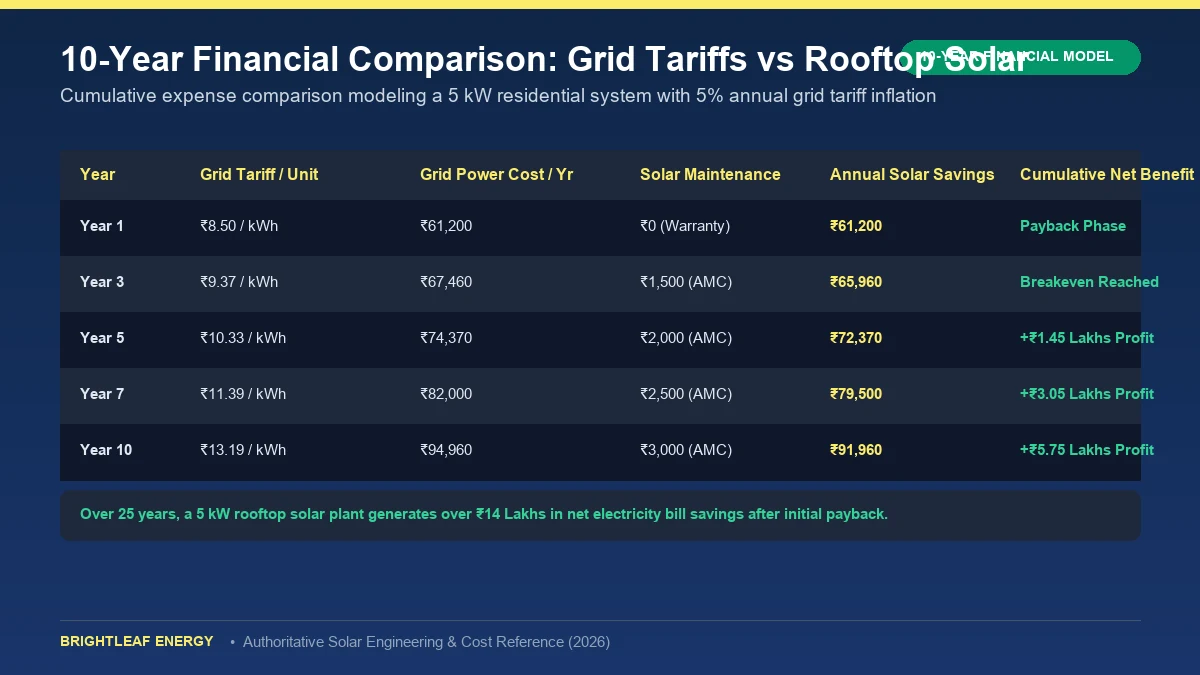
The solar payback period represents the time required for cumulative electricity savings to recover the net investment made in the solar system. The basic formula is: Payback Period = Net Solar Investment ÷ Annual Electricity Savings
For example, Brightleaf's online solar calculator provides an illustrative residential scenario showing estimated system cost, subsidy, annual savings and payback. These figures are estimates and should not be treated as guaranteed results for every household or system size.
Actual savings can vary because of:
- Electricity consumption
- Electricity tariff
- Solar generation
- System capacity
- Roof orientation
- Shading
- Equipment performance
- Installation cost
- Applicable subsidy
- Financing costs
- Changes in electricity tariffs
Why Does Solar Payback Differ Between Homes?
Two households can install similarly sized solar systems but experience different savings. A household with higher electricity consumption may have a different savings profile from a household with lower consumption.
Likewise, a shaded rooftop may generate less electricity than a comparable system installed on an unobstructed roof. This means Home Solar Power Cost should not be evaluated separately from expected electricity savings.
A useful financial assessment looks at: Upfront Cost → Subsidy → Net Investment → Electricity Savings → Payback → Long-Term Value
The objective is not simply to identify the cheapest solar installation, but to understand whether the proposed system is appropriately sized for the household.
How Can Financing Reduce Home Solar Energy Cost?
Upfront cost could be a very important factor to consider in determining the Home Solar Energy Cost.
Brightleaf Energy presently provides different financing methods such as Flexi Pay as well as bank loan schemes. The details can be clarified beforehand.
When evaluating financing, homeowners should compare:
- Total amount payable
- Interest or financing charges
- Loan tenure
- Monthly instalment
- Processing charges, if applicable
- Subsidy treatment
- Prepayment conditions
A lower monthly payment does not necessarily mean a lower total project cost. Therefore, compare the total financing cost along with the solar system quotation.
What Are The Common Mistakes When Calculating Solar Power For Home Cost?
1. Comparing Only The ₹/kW Price
While the lowest advertised ₹/kW price may not take everything into account, always make sure to consider the total system specification.
2. Assuming Every System Gets ₹78,000 Subsidy
₹78,000 is the highest possible central government subsidy that can be obtained for any residential solar rooftop under the PM Surya Ghar scheme. This should not necessarily be automatically deducted from all quotes.
3. Selecting Solar Capacity Only From Roof Size
A large roof doesn’t automatically translate into bigger system needs. The first priority must be electricity requirements
4. Ignoring Shading
Trees, neighbouring buildings, water tanks and other structures can affect the usable solar installation area.
5. Confusing Installation With The Complete Process
Installation is just one aspect of solar rooftop projects. There could be more processes involved including documentation, utility connection, metering and subsidy aspects.
6. Treating Estimated Savings As Guaranteed
Solar savings are contingent on a host of factors like generation, electricity consumption, electricity tariff rates and system specifics. Hence estimates must be taken as such.
Get Your Exact Solar Power For Home Cost
There is no single Solar Power For Home Cost that applies to every property. It depends on your consumption rate, power capacity, available roof space, components, installation needs and even subsidy eligibility.
Before choosing a system, homeowners should:
- Review their electricity consumption.
- Estimate the required solar capacity.
- Assess usable and shadow-free rooftop space.
- Check applicable subsidies.
- Compare complete system quotations.
- Estimate potential electricity savings.
- Calculate the expected payback period.
- Confirm the design through a site assessment.
If you want to move beyond a generic Home Solar Energy Cost estimate, use Brightleaf Energy's solar load calculator to understand your potential system requirement or request a customised assessment and quotation.
The right solar investment is not necessarily the one with the lowest initial price. It is the one where the system capacity, equipment, subsidy, installation scope and expected savings are clearly understood.
Compare System Sizes & City-Specific Subsidies in Delhi NCR
Compare system sizes and city-specific subsidies in Delhi NCR with our detailed solar cost guides.