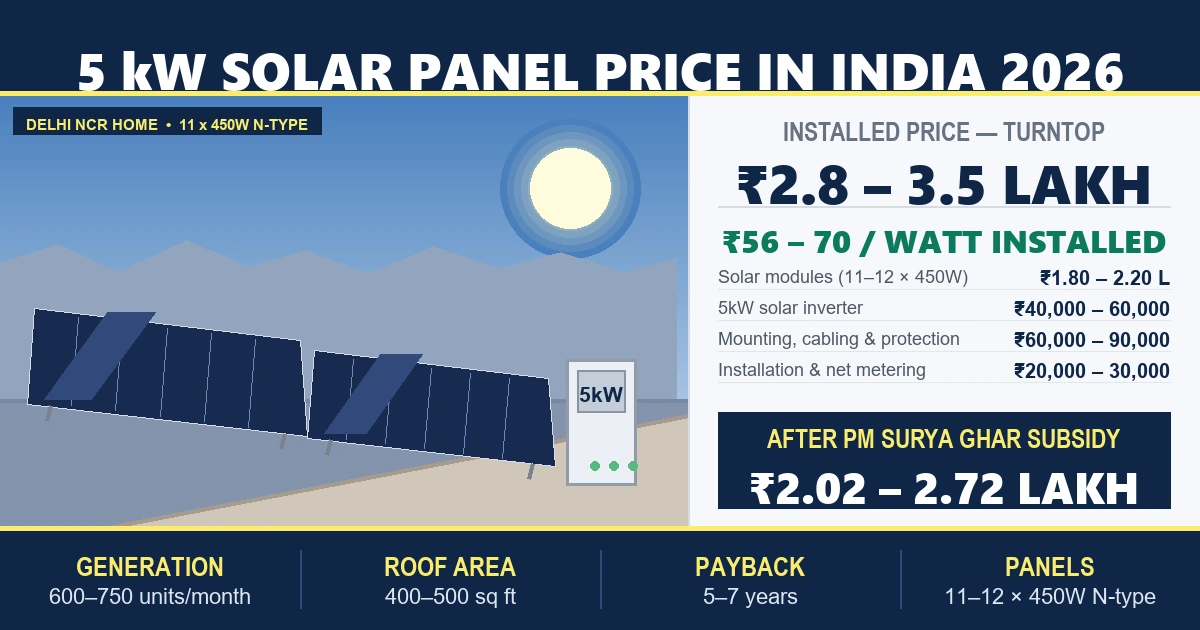
A 5 kW rooftop solar system in India costs about ₹2,80,000 to ₹3,50,000 in 2026, which works out to roughly ₹56 to ₹70 per watt installed. Solar modules are 60–66% of that cost (₹1,80,000–₹2,20,000), the 5 kW inverter adds ₹40,000–₹60,000, and mounting, cabling, protection and installation make up the balance. Under PM Surya Ghar, eligible homes receive a subsidy capped at ₹78,000 — the cap is reached at 3 kW and does not increase for the extra 2 kW — bringing the effective net price to roughly ₹2,02,000–₹2,72,000. A 5 kW array needs 11–12 × 450 W panels and about 400–500 sq ft of shadow-free roof, and generates 600–750 units a month in Delhi NCR.
- Pre-subsidy price: ₹2.80–₹3.50 lakh for a turnkey 5 kW residential system in Delhi NCR (₹56–₹70 per watt).
- Post-subsidy price: ₹2.02–₹2.72 lakh for eligible homes, because the PM Surya Ghar subsidy caps at ₹78,000 for any system above 3 kW.
- Hardware you need: 11–12 × 450 W N-type TOPCon modules (or 10 × 500 W), one 5 kW single-phase inverter, GI mounting, DC/AC cabling, ACDB/DCDB and earthing.
- Output:20–25 units a day, 600–750 units a month, 7,200–9,000 units a year in Delhi NCR's 4–5 peak sun hours.
- Space required: 400–500 sq ft of shadow-free rooftop, south-facing, tilted 10–15°.
- Payback: roughly 5–7 years for a well-sited residential system, shorter where daytime air-conditioner load and net metering are strong.
If you are searching for the 5 kW solar panel price in India, you have probably already seen four different numbers from four different sellers. That is not unusual. A 5 kW system is not a single product — it is a bundle of modules, an inverter, a mounting structure, cabling, protection equipment, labour and paperwork — and every one of those line items moves with brand, module wattage, roof geometry and how much of the work the seller actually includes.
This guide breaks the 5 kW price down the way an installer should: component by component, watt by watt, and then subsidy by subsidy. It also covers what a 5 kW system generates, how many panels it needs, and the specific mistakes that make 5 kW quotes expensive in Delhi NCR. For a broader view of system costs at every capacity, see our complete 3kW, 5kW and 10kW solar cost guide.
What Is a 5 kW Solar System?
A 5 kW solar system is a rooftop photovoltaic (PV) installation rated at 5 kilowatts peak (5 kWp) — the maximum electrical power it can produce under standard test conditions. In practice it is 5 kW of installed DC capacity on the roof paired with a 5 kW AC inverter that converts it into household-usable electricity. The "kW" in the quote describes the nameplate rating of the panels; the actual units you receive depend on sunlight hours, panel efficiency, orientation, shading and system losses.
5 kW is the most popular residential capacity in Delhi NCR. It comfortably supports a 3 to 4 BHK home running 500–800 units a month, and it is the size most first-time solar buyers land on because it clears the 3 kW subsidy threshold without pushing into commercial three-phase territory. If you are still deciding between capacities, our 1kW vs 3kW vs 5kW comparison walks through the sizing logic; if you want the full home economics, read solar power for home cost in India.
5 kW Solar Panel Price in India 2026: The Full Range
In 2026, an installed 5 kW rooftop solar system in India falls between ₹2,80,000 and ₹3,50,000 before subsidy for a standard single-phase residential installation. The spread is not arbitrary: it reflects module brand and wattage, inverter type, mounting standard, roof complexity, and whether net metering and subsidy paperwork are included or billed separately.
| 5 kW System Type | Price Before Subsidy | After ₹78,000 Subsidy | Notes |
|---|---|---|---|
| 5 kW On-Grid (single-phase, standard rooftop) | ₹2,80,000 – ₹3,10,000 | ₹2,02,000 – ₹2,32,000 | Most common home configuration. Needs net metering. |
| 5 kW On-Grid (elevated / industrial mounting) | ₹3,00,000 – ₹3,50,000 | ₹2,22,000 – ₹2,72,000 | Better airflow, higher yield, more structure cost. |
| 5 kW Hybrid (5 kW inverter + 2–5 kWh battery) | ₹4,20,000 – ₹5,50,000 | ₹3,42,000 – ₹4,72,000 | Battery largely self-funded. Subsidy caps at ₹78,000. |
| 5 kW Off-Grid (full backup, 10 kWh+ storage) | ₹6,50,000 – ₹9,00,000+ | ₹5,72,000 – ₹8,22,000+ | Backup-first design. Higher cost, lower daily yield. |
These are market ranges, not quotations. Brightleaf Energy publishes residential solar installations broadly in the ₹50,000 to ₹6,00,000 band, and the final 5 kW price for any specific property is confirmed only after a site assessment. Module prices, tariffs and scheme terms move through the year.
Component-Wise 5 kW Price Breakdown
The single biggest driver of the 5 kW solar panel price is the module array. Modules plus inverter account for roughly three-quarters of a residential 5 kW quotation. Everything else — structure, cabling, protection, labour and paperwork — makes up the remainder, and it is exactly the remainder that low-quality quotes tend to quietly omit.
| Component | Indicative Cost | Share of Total | What Changes This Number |
|---|---|---|---|
| Solar Modules (11–12 × 450 W N-type TOPCon, or 10 × 500 W) | ₹1,80,000 – ₹2,20,000 | 60–66% | Largest single line item. Module brand, wattage and efficiency move this number the most. |
| Solar Inverter (5 kW single-phase, hybrid-capable) | ₹40,000 – ₹60,000 | 12–18% | Converts DC to usable AC. Warranty length and brand reliability matter more than headline efficiency. |
| GI Mounting Structure, Rails & Clamps | ₹25,000 – ₹35,000 | 8–10% | Galvanised elevated mounting costs more than standard but improves output and panel life. |
| DC/AC Cabling, Earthing, ACDB/DCDB, Surge Protection | ₹15,000 – ₹25,000 | 5–8% | Frequently the line item missing from cheap quotes. Undersized protection is a real safety risk. |
| Installation, Commissioning & Net Metering Filing | ₹20,000 – ₹30,000 | 6–9% | Covers labour, testing and DISCOM paperwork. Subsidy documentation sits here too. |
| Total Pre-Subsidy (on-grid 5 kW) | ₹2,80,000 – ₹3,50,000 | 100% | ₹56 – ₹70 per watt |
What should always be in the quote
- • Module make, model, wattage and ALMM listing
- • Inverter make, capacity, warranty years and type
- • Mounting material (GI, not mild steel) and height
- • Cable gauge, earthing, ACDB/DCDB and SPD
- • Net metering application, CEIG/electrical inspection
- • Commissioning report and warranty registration
Red flags in a cheap 5 kW quote
- • A single lump-sum "per kW" rate with no bill of materials
- • Modules quoted without wattage or brand
- • "Unbranded" or non-ALMM modules to hit a price point
- • Protection equipment listed as optional extras
- • Net metering and subsidy paperwork charged as extra afterthoughts
If you want to know which module brands and models hold up best at this price point, our best solar panels for home use guide compares efficiency, warranties and real-world yield. For inverter-specific pricing, see our solar inverter price guide — the inverter is the second-largest line item and the piece most worth spending on.
Cost Per Watt: The Honest Way to Compare 5 kW Quotes
The fastest way to normalise two 5 kW quotations is to convert them into a cost per watt. Take the total quoted price, divide it by 5,000 watts, and you get a directly comparable figure. Anything far outside the ₹56–₹70 per watt band deserves an explanation.
| Cost Layer | Indicative Rate | What It Means |
|---|---|---|
| Modules only | ₹36 – ₹44 / watt | What you pay if you source panels yourself. |
| Full installed system (pre-subsidy) | ₹56 – ₹70 / watt | The number most 5 kW quotations resolve to. |
| Effective after ₹78,000 subsidy | ₹40 – ₹54 / watt | What an eligible residential buyer actually pays per watt. |
| Commercial / industrial 5 kW+ | ₹45 – ₹60 / watt | Lower per-watt cost at volume, but usually no residential subsidy. |
A worked example: a 5 kW quotation of ₹3,10,000 works out to ₹62 per watt installed. After the ₹78,000 PM Surya Ghar subsidy, an eligible homeowner pays ₹2,32,000, which is ₹46.40 per watt. That is the number to compare against other quotes — not the headline pre-subsidy total, and not a bare panel rate that quietly excludes the inverter, structure and installation.
5 kW Solar System Price After PM Surya Ghar Subsidy
The PM Surya Ghar: Muft Bijli Yojana pays ₹30,000 per kW for the first 2 kW and ₹18,000 per kW between 2 kW and 3 kW, then stops. The maximum central subsidy is ₹78,000, and it is reached at 3 kW. Every kW you add beyond that — including the 2 kW that makes up a 5 kW system — increases your capital cost without increasing the central subsidy.
| System Capacity | Price Before Subsidy | PM Surya Ghar Subsidy | Net Price You Pay |
|---|---|---|---|
| 2 kW | ₹1,20,000 – ₹1,40,000 | ₹60,000 | ₹60,000 – ₹80,000 |
| 3 kW | ₹1,80,000 – ₹2,10,000 | ₹78,000 (cap reached) | ₹1,02,000 – ₹1,32,000 |
| 5 kW (this guide) | ₹2,80,000 – ₹3,50,000 | ₹78,000 (max cap) | ₹2,02,000 – ₹2,72,000 |
| 10 kW | ₹4,80,000 – ₹6,50,000 | ₹78,000 (max cap) | ₹4,02,000 – ₹5,72,000 |
A 3 kW system costs less in net terms per kW of capacity than a 5 kW system, because both receive the same ₹78,000. That is not an argument for buying 3 kW — a 3 kW array will not offset a household running 600 units a month. It is an argument for checking your actual consumption against the 3 kW number before assuming more capacity is automatically better value.
Subsidy eligibility, documentation and the application sequence are covered in detail in our PM Solar Scheme 2026 eligibility and application guide. If you are in Delhi and want to check whether your consumption crosses the zero-bill or GBI cash-incentive thresholds, our Delhi solar panel subsidy guide covers the state-level incentives that stack on top of the central scheme.
On-Grid vs Hybrid vs Off-Grid 5 kW Pricing
The word "5 kW" describes the array. What you pay depends entirely on what sits beside it. An on-grid system exports surplus and imports the rest. A hybrid system adds a battery for backup. An off-grid system is designed to run the house without the grid at all. The panel count is the same; the price is not.
Lowest cost per watt. Best financial return. Requires net metering. No backup during outages.
2–5 kWh battery gives 2–4 hours of backup. Battery cost is largely self-funded. Best for homes with frequent outages or heavy evening load.
10 kWh+ storage plus charge controllers. Highest upfront cost, lowest daily yield, and only sensible where grid supply is unreliable or absent.
For most Delhi NCR households the on-grid system is the financially rational choice, because net metering already gives you most of the value a battery provides without the capital cost. If outages are the actual problem, a hybrid solar system sized around 5 kW of solar plus a modest battery is usually the better answer than a full off-grid build.
How Many Solar Panels Does a 5 kW System Need?
The panel count depends on module wattage, and module wattages have risen quickly. A 5 kW system built with 450-watt modules needs 11–12 panels. Built with 500-watt modules, it needs exactly 10. Built with older 335-watt modules, it would need 15. That is why two 5 kW quotations can look completely different at the panel count while both being honest — and why you should always ask for wattage alongside brand.
5,000 W ÷ 450 W per panel = 11.1 → 11 panels (4,950 W) or 12 panels (5,400 W). 5,000 W ÷ 500 W per panel = 10 → exactly 10 panels (5,000 W). Installers normally slightly oversize the DC array relative to the AC inverter because modules degrade and the inverter clips only at peak — a 5,400 W array on a 5 kW inverter is normal and is not an error.
Higher-wattage modules are not automatically cheaper. They usually cost slightly more per watt, but they cut the number of panels, the mounting hardware and the labour — which is where the real saving shows up on a constrained rooftop. Our best solar panels buying guide compares the brands most commonly specified at this capacity.
How Much Electricity Does a 5 kW Solar System Generate?
Delhi NCR receives roughly 4 to 5 peak sun hours a day across the year, with the strongest output between April and June. A well-oriented, unshaded 5 kW array in that band produces about 20 to 25 units a day, or 600 to 750 units a month.
| Output Metric | 5 kW Estimate | What Influences It |
|---|---|---|
| Daily generation | 20 – 25 units | 4–5 peak sun hours typical of Delhi NCR. |
| Monthly generation | 600 – 750 units | Before self-consumption and export split. |
| Annual generation | 7,200 – 9,000 units | Year 1 output at standard module warranty. |
| 25-year lifetime output | ~1.8 – 2.2 lakh units | Assuming ~0.5% annual degradation. |
| Monthly bill savings | ₹5,000 – ₹8,000 | Varies with tariff slab and usage timing. |
| Annual bill savings | ₹60,000 – ₹1,00,000 | Households with daytime AC load save most. |
What reduces real output
- • Shading from water tanks, parapets, trees or adjacent blocks
- • Dust and soiling in summer and post-construction
- • North or east-west facing orientation
- • Cable, temperature and inverter conversion losses (~10–14%)
- • Module degradation of roughly 0.4–0.6% per year
What raises real output
- • South-facing roof at 10–15° tilt in Delhi NCR
- • High-efficiency N-type TOPCon modules
- • Elevated GI mounting for airflow behind panels
- • String inverters sized for the array rather than undersized
- • Quarterly cleaning and annual performance review
The reason output matters as much as price is that it determines payback. 600–750 units a month offsets most of a typical Delhi NCR household bill, which is exactly why 5 kW is the sweet spot for a 3–4 BHK home. Our benefits of installing solar panels at home guide covers the full financial and practical case, and our 10-year rooftop solar vs grid electricity comparison runs the numbers year by year.
5 kW Solar Price: Home vs Business
A 5 kW system means something different commercially. Businesses usually run higher loads, qualify for accelerated depreciation rather than a residential subsidy, and frequently move to three-phase supply — which changes both the price per watt and the earnings treatment.
| Factor | Residential 5 kW | Commercial / Industrial 5 kW |
|---|---|---|
| Cost per watt | ₹56 – ₹70 | ₹45 – ₹60 |
| Government support | PM Surya Ghar up to ₹78,000 | Generally no residential subsidy; depreciation instead |
| Tax treatment | No depreciation benefit for individuals | Accelerated depreciation on commercial income |
| Typical payback | 5–7 years | 3–6 years |
| Supply type | Single-phase, up to 5 kW | Three-phase, 5 kW and above |
If the 5 kW figure came from a shop, hotel, clinic or factory rather than a home, the economics and the applicable incentives both change. Our solar panels for business ROI guide covers sector-wise payback and the depreciation angle, and our solar tax benefits in India guide details GST, HSN codes and depreciation rates. For commercial EPC across the region, see our commercial solar solutions page.
What Raises or Lowers Your Final 5 kW Price
Two 5 kW systems in the same society can differ by ₹40,000 or more for entirely legitimate reasons. These are the variables that account for it — and the ones worth negotiating on.
Factors that lower the price
- • Flat, unobstructed roof with straightforward cable routing
- • Standard single-phase supply already at the meter
- • South-facing orientation with minimal shading
- • Grid-tied configuration instead of hybrid battery storage
- • Eligible PM Surya Ghar subsidy applied at commissioning
- • Bundled panel + inverter purchase rather than piecemeal sourcing
- • Financing that spreads cost instead of upfront payment
Factors that raise the price
- • Sloped, fragmented or multi-level rooftops needing extra mounting
- • Shading from tanks, staircases, trees or neighbouring towers
- • Hybrid battery storage added to the quoted capacity
- • Existing electrical panel needing replacement or extension
- • Three-phase conversion or long DC cable runs from meter to roof
- • Premium module brands or extended product warranties
- • High-altitude or difficult access sites needing special logistics
Roughly 30–40% of the 5 kW price is set by hardware choices you control (module brand, inverter brand, mounting standard). The rest is set by the building and the site. Negotiate hard on the first group, and get an honest assessment on the second.
Roof Space, Orientation & Shading
A 5 kW system needs approximately 400 to 500 square feet of shadow-free rooftop. What matters is not total roof area but usable, shade-free area after water tanks, staircases, parapets, lift machine rooms and ducts are subtracted. On many Indian rooftops the usable area is 40% less than the flat area suggests.
| Specification | Requirement for 5 kW |
|---|---|
| Roof area required | 400 – 500 sq ft (37 – 46 sq m) |
| Module count (450 W) | 11 – 12 panels |
| Module count (500 W) | 10 panels |
| Panel dimensions (typical) | ~1.78 m × 1.13 m each |
| Preferred roof orientation | South-facing, 10–15° tilt |
| Usable vs total roof area | Shadow-free usable area is what matters |
Orientation matters enormously for the 5 kW yield. A south-facing array at 10–15° tilt performs best in Delhi NCR; east-west arrangements produce roughly 15–20% less annual output but spread generation across morning and evening, which can suit households with very little daytime load. Shading from a single water tank during peak hours can cost more than a full percentage point of annual yield. Our step-by-step home solar installation guide walks through what happens on site, and our solar installation process guide covers approvals, paperwork and commissioning timelines.
Financing a 5 kW System: EMI and the Real Cost
₹2–3 lakh is a real upfront number for most households. Financing changes when you pay, not what you pay — so the comparison that matters is total interest, not the monthly instalment. Brightleaf Energy currently offers Flexi Pay as well as bank loan options, and the details can be discussed before commitment.
| Compare On | Why It Matters |
|---|---|
| Total amount payable | Not the monthly EMI — the full sum across the tenure |
| Interest rate and tenure | A longer tenure lowers the EMI and raises the interest |
| Subsidy treatment | Confirm whether the ₹78,000 reduces the loan or the cash component |
| Prepayment penalty | Early solar customers often repay early — read this clause |
| Processing fees | One-time charges that never appear in the headline rate |
A ₹2,32,000 net 5 kW system that saves ₹5,500 a month pays for itself in under four and a half years on cash flow. Adding two years of loan interest still leaves a clearly positive position — which is why most of our customers finance rather than delay. For a deeper look at payback modelling, see our solar installation cost recovery guide.
What to Check Before Accepting a 5 kW Quote
Before you compare numbers, make sure both quotations describe the same system. Here is the checklist that separates a real 5 kW quotation from a headline price.
If you are still comparing vendors, our how to choose a solar installer guide covers MNRE registration, ALMM compliance and what a written warranty should say. And if a seller is quoting modules only, read our online panels vs local dealer comparison before deciding that route looks cheaper.
Common Mistakes Buyers Make With 5 kW Systems
Frequently Asked Questions (FAQ)
1What is the price of a 5 kW solar panel system in India in 2026?
A 5 kW rooftop solar system in India costs roughly ₹2,80,000 to ₹3,50,000 before subsidy in 2026, equivalent to about ₹56 to ₹70 per watt installed. After the PM Surya Ghar subsidy of up to ₹78,000, the effective net cost for an eligible residential buyer falls to roughly ₹2,02,000 to ₹2,72,000, or ₹40 to ₹54 per watt.
2How many solar panels are needed for a 5 kW system?
A 5 kW system needs 11 to 12 panels of 450-watt N-type TOPCon modules, or exactly 10 panels of 500-watt modules. Because panel wattages keep rising, two 5 kW quotations built the same month can contain different panel counts. Always ask for the module wattage and the number of modules, not just the kW rating.
3How much does a 5 kW solar system cost after the PM Surya Ghar subsidy?
Eligible residential buyers receive a central subsidy of ₹30,000 per kW up to 2 kW and ₹18,000 per kW between 2 kW and 3 kW, capped at ₹78,000. Because 5 kW exceeds 3 kW, the subsidy stays at the ₹78,000 maximum. On a ₹2,80,000 to ₹3,50,000 quotation, the post-subsidy net cost is ₹2,02,000 to ₹2,72,000.
4How much electricity does a 5 kW solar system generate per day and per month?
In Delhi NCR, which receives roughly 4 to 5 peak sun hours a day, a 5 kW system generates about 20 to 25 units per day, 600 to 750 units per month, and 7,200 to 9,000 units per year. Actual output depends on panel efficiency, roof orientation, shading, dust, and system losses.
5How much roof space is required for a 5 kW solar system?
A 5 kW system needs approximately 400 to 500 square feet of shadow-free rooftop area (about 37 to 46 square metres) when using modern 450-watt modules. Usable shadow-free area matters far more than total roof area, because water tanks, staircases, parapets, and adjacent buildings can each remove several square metres from the usable layout.
6Is a 5 kW solar system enough for a 3 or 4 BHK home?
For most 3 to 4 BHK homes in Delhi NCR using 500 to 800 units a month, 5 kW is a well-matched size. It comfortably handles two to three air conditioners, a refrigerator, a washing machine, water pumps, and lighting. Homes consistently consuming above 900 units a month, or planning an EV charger or additional floor, usually need 8 kW or more.
7How much does a 5 kW hybrid solar system with a battery cost?
A 5 kW hybrid system with a 2 to 5 kWh lithium battery typically costs ₹4,20,000 to ₹5,50,000 installed, before considering subsidy. The central PM Surya Ghar subsidy applies to the eligible rooftop capacity but does not separately subsidise battery storage, so the battery largely remains a self-funded component. Full off-grid backup with 10 kWh or more of storage can exceed ₹6,50,000.
8Is a 5 kW system eligible for the ₹78,000 subsidy, or only 3 kW systems?
A 5 kW system is eligible, but the subsidy does not scale beyond 3 kW. The PM Surya Ghar structure pays ₹30,000 per kW up to 2 kW, then ₹18,000 per kW up to 3 kW, and stops there. Every kW above 3 kW adds capital cost without adding central subsidy, which is a common and expensive misunderstanding among buyers.
9What is the payback period on a 5 kW solar system?
A well-designed 5 kW residential system in Delhi NCR typically recovers its net cost in roughly 5 to 7 years, and faster for households with air conditioner loads during daytime. Payback shortens when net metering is active, electricity tariffs are higher, and shading is minimal. It lengthens on shaded or split roofs and when a large battery is added for backup that is rarely used.
10How can I tell whether a 5 kW quote is fair?
Compare four things, not the headline number: the cost per watt including modules, inverter, structure, cabling and installation; the module make, wattage and warranty; the inverter make, capacity and warranty; and whether the quote itemises net metering paperwork and subsidy documentation. A quote that only lists a lump-sum kW rate without a bill of materials is not comparable to one that itemises the system.
11Does a 5 kW solar system need net metering in India?
Yes, net metering is what makes a 5 kW system financially worthwhile. Without it, surplus generation generated during the day is effectively wasted because your DISCOM buys it back at a low commercial rate. Net metering lets exported units offset units you import, so the system offsets the full value of what it produces. Your DISCOM must approve and commission the meter before export begins.
12Is buying a 5 kW system online cheaper than from a local installer?
Module prices are similar either way, since the same brands and ALMM-listed models are sold through both channels. The difference is in what is bundled: an online module-only purchase excludes the inverter, mounting structure, cabling, protection equipment, installation quality, net metering paperwork, and warranty accountability. For a full 5 kW system, the turnkey quote is usually the more comparable number to evaluate.
Conclusion & Key Takeaways
The 5 kW solar panel price in India in 2026 is a fairly narrow band once you know what you are comparing: ₹2.80–₹3.50 lakh installed, or ₹56–₹70 per watt, dropping to roughly ₹2.02–₹2.72 lakh for eligible homes after the ₹78,000 PM Surya Ghar subsidy. The variation inside that band is almost entirely explained by module brand and wattage, inverter quality, mounting standard, and how much of the installation scope the seller actually includes.
Key Takeaways
- • Budget ₹2.80–₹3.50 lakh for a turnkey on-grid 5 kW system in Delhi NCR in 2026.
- • Compare quotations at ₹56–₹70 per watt installed, never at module price per watt.
- • Modules are 60–66% of the cost; the inverter is the second-largest and most important line.
- • The ₹78,000 subsidy caps at 3 kW — the extra 2 kW adds capacity, not subsidy.
- • You need 11–12 × 450 W panels and 400–500 sq ft of shadow-free, south-facing roof.
- • Expect 600–750 units a month and a 5–7 year payback on a well-sited system.
- • Net metering approval is what makes the economics work — confirm it is in scope.
- Pull your last 12 months of electricity bills and note the average monthly units.
- Estimate usable shadow-free roof area, not total roof area.
- Run the numbers through a load calculator to confirm whether 5 kW matches your usage.
- Check PM Surya Ghar eligibility and what documentation you already hold.
- Request two or three itemised quotations with module and inverter models named.
- Convert each quotation to a cost per watt for an apples-to-apples comparison.
- Confirm net metering, commissioning and subsidy paperwork are inside the scope.
- Validate the design through an on-site assessment before signing.
Brightleaf Energy provides end-to-end residential and commercial solar EPC across Delhi, Noida, Greater Noida, Gurugram, Ghaziabad and Faridabad — including design, installation, net metering liaison and subsidy documentation.
Get an Itemised 5 kW Quotation for Your Home
Share your bills and roof details, and we will return a system design with module and inverter models, cost per watt, and expected generation.
Sources & Official References
- PM Surya Ghar: Muft Bijli Yojana — Official Portal (subsidy structure, ₹30,000/kW up to 2 kW, ₹18,000/kW to 3 kW, ₹78,000 maximum)
- Ministry of New & Renewable Energy (MNRE) — rooftop solar guidelines, ALMM listing and DCR framework
- MNRE Solar PV Cell Information — module efficiency and performance standards
Module and inverter prices, DISCOM tariffs, net metering rules and subsidy terms change through the year and vary by state and utility. Verify all figures against the official portals above and against your own DISCOM before making a financial decision. Prices in this guide are indicative market ranges published October 2026, not quotations.