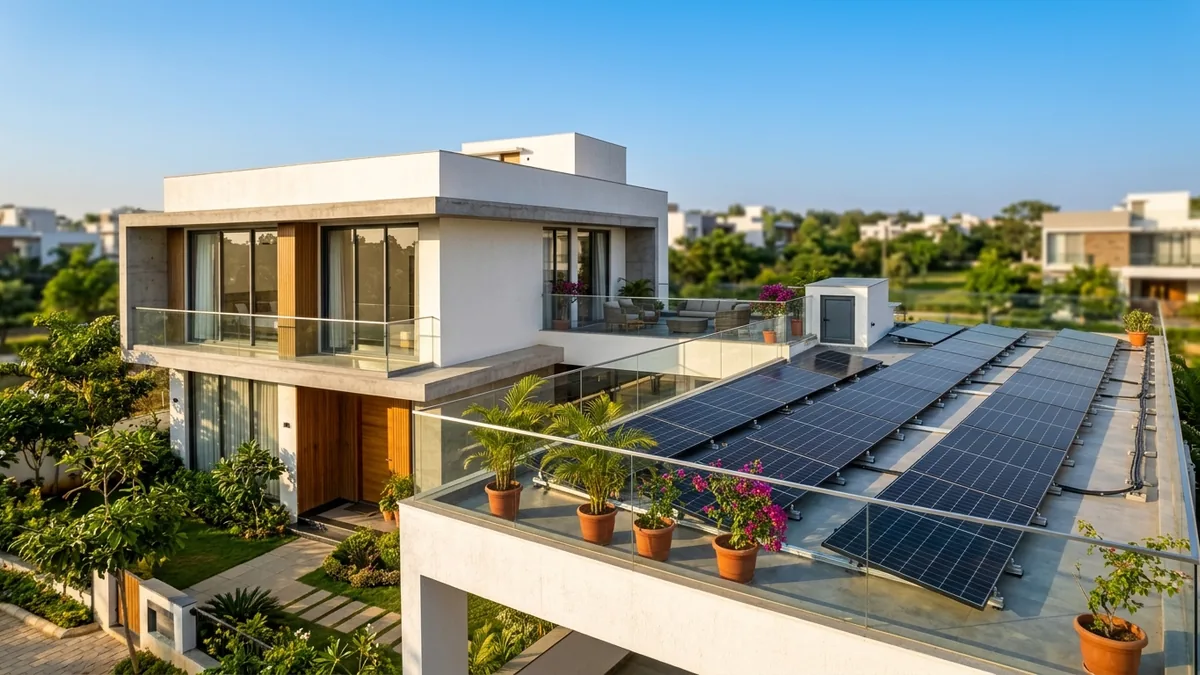
Key Takeaway for Homeowners
Finding the best solar panels for home in India is not about selecting the cheapest price per panel or blindly buying the highest wattage. The right system hinges on your monthly electricity bill, available shadow-free rooftop space, cell efficiency, summer heat tolerance, warranty terms, and net metering compatibility. Government incentives under the PM Surya Ghar: Muft Bijli Yojana now provide up to ₹78,000 in direct central subsidies, making high-efficiency solar more lucrative than ever.
Why Are Solar Panels the Best Choice for Home Use?
For Indian households, installing residential rooftop solar is the single most effective hedge against constantly rising grid power tariffs. The ideal residential solar panel produces maximum kilowatt-hours (kWh) per square foot of terrace, withstands high ambient temperatures, and delivers dependable power over a 25+ year lifespan.
However, a solar panel that excels on a vast rural bungalow might not be the right choice for a compact urban terrace in Delhi NCR. Terrace dimensions, water tanks, parapet shading, daily air conditioner consumption, and local electricity distribution company (DISCOM) net-metering regulations all shape the ideal configuration.
Key Factors to Compare in a Home Solar Panel
Solar panel efficiency is the percentage of sunlight that a photovoltaic panel converts into usable electrical power. Higher-efficiency panels produce substantially more electricity from the same rooftop area, making them indispensable when terrace footprint is limited.
| Factor | Why It Matters for Homeowners | Priority |
|---|---|---|
| Panel Efficiency | Determines how effectively the module converts incoming sunlight into usable electricity (typically 20%–22.5%+ for modern mono/TOPCon). | High |
| Cell Technology | Mono PERC and N-Type TOPCon offer lower degradation, superior weak-light performance, and higher lifetime kilowatt-hour output. | High |
| Module Wattage | Ranging from 450W to 590W+; dictates how many physical panels are required to achieve your target 3kW, 5kW, or 10kW system capacity. | Medium |
| Product & Performance Warranty | Ensure at least 10–12 years product defect warranty and 25–30 years linear performance output warranty (guaranteeing ≥80% at year 25). | Critical |
| Temperature Coefficient | Measures generation loss as surface temperature rises above 25°C. Lower negative values (-0.30%/°C) generate more power in Indian summers. | High |
| Total System Price & Balance of System (BOS) | Must be weighed alongside expected 25-year generation yield, inverter reliability, and structure quality rather than hardware price alone. | High |
| EPC Installer Quality & DISCOM Liaison | Flawless rooftop mounting, hot-dip galvanized structures, surge protection, and end-to-end net metering liaison determine system longevity. | Critical |
Pro Tip: Never evaluate efficiency in isolation. A tier-1 module with 21.5% efficiency backed by a robust warranty and local EPC support often yields better lifetime value than an overpriced 23% module with unverified after-sales service.
Types of Solar Panels for Home Use
Residential rooftop solar modules differ in their silicon cell architecture, efficiency, temperature performance, degradation rates, and price points. The three primary technologies homeowners encounter today are:
1. Monocrystalline (Mono PERC)
Manufactured from single, high-purity cylindrical silicon ingots. Distinct uniform black appearance with cut edges.
- High efficiency (20% – 21.8%)
- Exceptional generation in limited roof spaces
- Industry-proven 25-year reliability in India
- Optimal balance of price, yield, and availability
2. Polycrystalline Panels
Constructed by melting multiple raw silicon fragments together. Recognizable by their speckled, iridescent blue finish.
- Lower efficiency (16% – 18%)
- Requires 30%–40% more rooftop surface area
- Higher temperature loss in hot summers
- Being phased out by Tier-1 manufacturers
3. N-Type TOPCon Panels
Tunnel Oxide Passivated Contact cells using N-type silicon wafers. The cutting-edge benchmark for modern residential solar.
- Ultra-high efficiency (22% to 23.5%+)
- Near-zero Light-Induced Degradation (LID)
- Lowest thermal degradation in 42°C+ summers
- Up to 30-year performance guarantees
Homeowners in North India looking to compare Tier-1 brands can review our in-depth analysis of the best solar panels in Noida featuring Tata Power Solar, Waaree Energies, Adani Solar, and Vikram Solar.
Monocrystalline vs Polycrystalline vs N-Type TOPCon
| Feature | Monocrystalline (Mono PERC) | Polycrystalline | N-Type TOPCon |
|---|---|---|---|
| Average Efficiency | 20.5% – 21.8% | 16.5% – 18.0% | 22.0% – 23.2%+ |
| Roof Space Efficiency | High (approx. 70–80 sq.ft per kW) | Lower (approx. 100–120 sq.ft per kW) | Maximum (approx. 60–70 sq.ft per kW) |
| Temperature Coefficient | Good (-0.35% to -0.38% / °C) | Average (-0.40% to -0.45% / °C) | Superior (-0.29% to -0.32% / °C) |
| Annual Degradation | Approx. 0.55% / year | Approx. 0.70% – 0.80% / year | Ultra-low (<0.40% / year) |
| Suitability for Urban Rooftops | Excellent for standard terraces | Only if vast, unshaded space is available | Best for compact or premium terraces |
| 25-Year Long-Term Value | High (Proven workhorse in India) | Declining (Outpaced by modern mono) | Highest lifetime generation ROI |
How Much Solar Capacity Does Your Home Need?
Determining your residential solar capacity begins with your past 12 months of electricity bills. Summer air conditioning demands often double or triple power usage compared to winter months.
Basic Sizing Formula
Required Solar Capacity (kW) ≈ Annual Electricity Units (kWh) ÷ 1,450 kWh (Expected Annual Generation per kW)
In North India (Delhi NCR, Haryana, UP), 1 kW of well-aligned, shadow-free solar panels generates approximately 4.0 to 4.5 kWh per day, or ~1,400 to 1,550 kWh annually.
| System Size | Monthly Generation | Required Roof Space | Typical Household Application | Guide |
|---|---|---|---|---|
| 1 kW Solar System | 120 – 140 Units | approx. 70 – 100 sq.ft | 1BHK apartments, small homes, or essential base loads (lights, fans, TV). | Details |
| 2 kW Solar System | 240 – 280 Units | approx. 140 – 180 sq.ft | 2BHK homes with 1 split air conditioner, refrigerator, and water pump. | Details |
| 3 kW Solar System | 360 – 420 Units | approx. 200 – 260 sq.ft | Most popular residential size; 3BHK homes, 2 ACs, unlocks max ₹78k subsidy. | Details |
| 5 kW Solar System | 600 – 700 Units | approx. 350 – 450 sq.ft | Large independent villas, floors with 3–4 ACs, EV charging, heavy daytime loads. | Details |
| 10 kW Solar System | 1,200 – 1,400 Units | approx. 700 – 900 sq.ft | Multi-story kothis, luxury villas, home elevators, 5+ air conditioners. | Details |
Need an instantaneous estimate for your exact appliances and sanctioned load? Try our interactive Solar Load Calculator to find your custom system size in 60 seconds.
Roof Space, Efficiency and Panel Wattage: What to Choose?
Available shadow-free roof area directly dictates what solar panels make financial and practical sense. If you have a sprawling, unobstructed terrace, you have flexibility across various module ratings. If terrace space is tight, high-efficiency TOPCon or Mono PERC half-cut panels (540Wp–580Wp) are crucial.
Understanding Wattage vs. Efficiency:
A 550W panel is not inherently "better" than a 450W panel. Often, a 550W panel is simply 20% physically larger. If both have 21.5% cell efficiency, they convert the same amount of solar energy per square meter. However, higher wattage per panel means fewer total panels on your roof, reducing mounting clamps, cabling, and installation labor.
Don't Ignore Shade: Protecting Your Generation Yield
Even the world's most expensive solar panels will underperform dramatically if parts of the array fall under regular shadow. In a traditional string inverter setup, shading just one panel can drag down the power output of the entire string.
Overhead water storage tanks, parapet boundary walls, elevator mumty rooms, staircases, satellite dishes, and neighboring taller buildings.
Elevated elevated superstructures (walkway-height structures), half-cut cell panels with bypass diodes, or microinverters/optimizers for complex roofs.
At Brightleaf Energy, every project begins with a 3D shadow analysis mapping sunlight angles across all 365 days before finalizing layout.
On-Grid vs Hybrid Solar: Which Is Best for Home Use?
1. On-Grid (Grid-Tied) Solar System
Operates in synchronization with your local electricity grid. Powers your appliances during the day, and exports surplus clean energy to the grid via a bi-directional net meter.
- Lowest initial capital investment (no expensive battery bank)
- Eligible for full PM Surya Ghar central subsidies up to ₹78,000
- Shortest payback period (typically 3 to 4.5 years)
- Lowest maintenance with zero battery replacement overhead
Note: Shuts off during grid blackouts for safety reasons (anti-islanding protection).
2. Hybrid Solar System
Combines solar panel generation, grid export capabilities, and lithium-ion battery storage. Provides seamless uninterrupted backup when the utility grid fails.
- Keeps critical loads (lights, fans, routers, refrigeration) running during outages
- Higher total investment (batteries add ₹80,000–₹2,00,000+ depending on capacity)
- Subsidies apply primarily to the solar module and on-grid inverter portion
- Slightly longer payback period (5 to 7 years)
Compare inverter options in our comprehensive Solar Inverter Price Guide.
Solar Costs, PM Surya Ghar Subsidy & 25-Year ROI Math
The total turnkey price of a residential rooftop solar system includes Tier-1 solar panels, an on-grid solar inverter, pre-galvanized structural mounting hardware, AC/DC distribution boxes, copper earthing, lightning arrestors, and DISCOM net metering approvals.
PM Surya Ghar: Muft Bijli Yojana Central Subsidy (2026)
Direct Bank Transfer (DBT)Learn eligibility, portal paperwork, and timelines in our full PM Surya Ghar Application Guide. Also check regional benefits like the Delhi Solar Panel Subsidy.
Think Beyond the Upfront Price Tag:
Solar is a capital asset generating free electricity for 25 to 30 years. A 3 kW solar system costs approximately ₹1,65,000 to ₹1,95,000 before subsidy. After applying the ₹78,000 central subsidy, your effective out-of-pocket investment drops to approximately ₹87,000 – ₹1,17,000.
With average monthly electricity bill savings of ₹2,500 – ₹3,500, your entire investment is recovered in 3 to 4 years. Over the remaining 21+ years of warranty life, the system produces over ₹8,00,000 in pure cumulative savings.
8-Point Checklist Before Buying Solar Panels for Your Home
Before signing a contract or committing to a solar quote, verify these 8 vital criteria with your installer:
1. Verify ALMM & BIS Certification
Ensure modules are listed on the MNRE Approved List of Models and Manufacturers (ALMM). Only ALMM-listed domestic cells qualify for government subsidies.
2. Compare Cell Technology (Mono PERC vs. N-Type TOPCon)
Opt for high-efficiency half-cut Mono PERC or TOPCon modules. Avoid outdated polycrystalline panels unless terrace space is limitless and budget is extremely tight.
3. Distinguish Between Product & Performance Warranties
Make sure you receive two separate warranties: a 10–12 year Product Defect Warranty and a 25–30 year Linear Output Performance Warranty.
4. Conduct a Thorough Structural Roof & Shade Assessment
Inspect terrace RCC slab strength, parapet heights, orientation (true South is optimal), and seasonal shadow paths from neighboring buildings.
5. Scrutinize the Inverter Quality & Monitoring Capabilities
The inverter is the brain of your system. Choose high-efficiency IP65-rated on-grid string inverters with built-in Wi-Fi mobile monitoring.
6. Check Mounting Structure Quality & Corrosion Resistance
Insist on Hot-Dip Galvanized (HDG) iron (≥80 microns) or anodized structural aluminium to resist 25 years of outdoor rain, heat, and rust.
7. Clarify the DISCOM Net-Metering Liaisoning Process
Confirm whether your solar EPC handles the entire DISCOM application, feasibility approval, bi-directional meter procurement, and commissioning.
8. Demand an Itemized Turnkey Quotation
Do not accept a single lump-sum number. Verify module make/wattage, inverter model, cable specs (e.g., solar-grade DC cables), earthing rods, and after-sales support SLAs.
Debating whether to buy online or through a local turnkey EPC? Read our guide on Buying Solar Panels Online vs Local Dealer: What Is Better?
Frequently Asked Questions (FAQ)
1.Which type of solar panel is best for home use in India?
High-efficiency Monocrystalline (specifically Mono PERC) and N-Type TOPCon modules are currently the best options for residential rooftops in India. They deliver superior 21% to 22.5%+ efficiency, stronger heat tolerance during harsh Indian summers, and produce maximum kilowatt-hours from compact terrace spaces. The best option depends on your available shadow-free roof area, power consumption, and budget.
2.How many solar panels do I need for my home?
The number of panels depends on your required system capacity and each panel's wattage rating. For example, a standard 3 kW solar system using 500W high-efficiency modules requires only 6 panels (500W × 6 = 3,000W). If 550W panels are chosen, just 5 to 6 panels will suffice, conserving valuable terrace space.
3.Are N-type TOPCon solar panels worth the extra cost?
Yes, especially for urban homes where roof space is constrained and long-term energy yield is prioritized. TOPCon panels feature lower initial Light-Induced Degradation (LID), a superior temperature coefficient (generating more power in 40°C+ summer weather), and slower annual degradation (<0.4% per year), which delivers significantly higher cumulative 25-year financial savings.
4.How long do residential solar panels last?
Tier-1 residential solar panels have an expected operational lifespan of 25 to 30+ years. Most reputable manufacturers provide a 10–12 year product warranty against defects and a 25–30 year linear power performance warranty guaranteeing at least 80% to 87.4% output at year 25.
5.Do I need a battery storage system with my home solar panels?
No, a battery is not mandatory for all homes. If your locality has a dependable electricity grid and your main objective is slashing electricity bills by 70% to 90%, an on-grid solar system with DISCOM net metering is the most cost-effective solution. A hybrid system with battery storage is recommended only if you suffer frequent power outages or desire complete off-grid energy independence.
6.Is a higher-wattage solar panel always better?
Not necessarily. Higher wattage (e.g., 550W vs 450W) means higher total output per module, but it often comes from physically larger dimensions rather than higher cell efficiency. You must evaluate module efficiency (percentage of sunlight converted), temperature coefficients, degradation curves, and structural roof fit alongside wattage.
7.Can solar panels completely eliminate my electricity bill?
Solar energy can reduce electricity bills by up to 80% to 90%+. However, under Indian DISCOM net metering regulations, consumers still pay nominal fixed connection charges, electricity duties, and meter rent. Under initiatives like the Delhi Solar Policy or high solar generation matching daytime usage, bills can often be reduced to near zero.
8.Should I buy the cheapest solar panel quotation available?
No. Solar is a 25-year capital investment. Extremely low-cost quotes often cut corners on non-ALMM uncertified cells, lightweight aluminium structures, low-grade DC cables, and sub-standard inverters. A slightly higher upfront investment in Tier-1 panels, certified mounting hardware, and professional EPC engineering yields far greater reliability, safety, and lifetime financial return.
Choosing the Best Solar Panels Means Choosing the Right Complete System
There is no single solar panel brand that suits every single property. The ideal solution balances your actual monthly unit consumption, available terrace dimensions, structural orientation, inverter architecture, and long-term financial goals.
Remember: solar panels are only one component of a 25-year power plant. Inverter performance, hot-dip galvanized mounting structures, precision electrical safety cabling, DISCOM net metering, and proactive after-sales maintenance all determine whether your system runs at peak yield.