If you have noticed your electricity bills creeping up over the past couple of summers, you are not alone. A lot of Delhi homeowners and business owners are now seriously looking into rooftop solar — not as a trend, but as a practical way to manage rising power costs over the long run. Solar installation in Delhi has become a lot more accessible in recent years, thanks to better equipment, more experienced local installers, and government support through schemes like PM Surya Ghar: Muft Bijli Yojana.
That said, the questions people ask before installing solar are usually the same: How much will it actually cost? Is my roof even suitable? What subsidy am I eligible for? Will it work during a power cut? This guide walks through all of that in plain language — system types, pricing factors, the subsidy process, realistic savings expectations, installation steps, and how to pick an installer you can trust.
home solar installation step-by-step guide, solar installation process in India, solar payback period and cost recovery time and solar blogs and guides.
Why Consider Solar Installation in Delhi?
Rooftop solar works on a simple principle: solar panels convert sunlight into electricity during the day, which either powers your home directly or gets exported to the grid, depending on the type of system. For most residential and commercial properties in Delhi, the main attraction is the potential reduction in electricity bills over the system’s lifetime.
A few practical reasons people in Delhi are evaluating solar right now:
- Underused rooftop space. Independent houses, builder floors, and commercial buildings often have flat or sloped rooftops that sit empty for most of the day — a reasonably good candidate for panels if shading is not a major issue.
- Daytime electricity consumption. Offices, shops, schools, and small manufacturing units that consume most of their electricity between 9 am and 6 pm are often well suited to solar, since that is exactly when generation peaks.
- Long-term cost management. A correctly sized system can offset a meaningful share of annual electricity consumption, which matters over a 20–25 year panel lifespan.
- Lower reliance on grid power during sunlight hours, which can be useful for properties with high daytime load.
- Environmental impact — generating electricity from sunlight instead of fossil-fuel-based grid power.
Solar is not a one-size-fits-all solution. The actual benefit you get depends on your consumption pattern, available rooftop area, shading from neighbouring buildings or water tanks, the tariff structure your DISCOM applies, and how the system is designed. A good installer will assess all of this before quoting a number.
Types of Solar Systems Available in Delhi
Before deciding on “how much” or “which company,” it helps to understand the three broad categories of solar systems, because the right choice depends heavily on your situation.
On-Grid Solar System
An on-grid (or grid-tied) system is connected directly to the DISCOM’s electricity network. During the day, solar power is used first; any surplus generated beyond your consumption is exported to the grid, and under applicable net-metering arrangements, this export can offset the electricity you draw from the grid at other times. This is the most common and generally most cost-effective option for homes and businesses that primarily want to reduce their electricity bills.
The important caveat: a standard grid-tied system is designed to shut down automatically during a power outage, as a safety measure to protect utility line workers. So if you are expecting backup power during a cut, a plain on-grid system will not give you that unless it is specifically designed with additional backup provisions.
Off-Grid Solar System
An off-grid system operates independently of the DISCOM grid and stores generated electricity in batteries for use when the sun is not shining. This setup is more relevant for locations without a reliable grid connection, which is uncommon in most parts of Delhi, but it does appear in specific niche applications. Off-grid systems cost noticeably more than grid-tied systems of the same capacity because of the battery bank, and batteries also add ongoing maintenance and periodic replacement costs.
Hybrid Solar System
A hybrid system combines grid connectivity with battery storage, giving you the bill-saving benefit of grid-tied operation plus some backup capability during outages. It is a reasonable middle path for properties where power cuts are a genuine concern, but it comes with a higher initial investment than a simple on-grid system, and the backup duration depends entirely on the battery capacity installed — it typically is not designed to run your entire household load indefinitely. You can compare battery sizing and backup hours in our hybrid solar system cost and benefits guide.
| Feature | On-Grid | Off-Grid | Hybrid |
|---|---|---|---|
| Grid connection | Yes | No | Yes |
| Battery required | No | Yes | Yes |
| Backup during power cut | No (standard setup) | Yes | Yes, limited by battery size |
| Relative initial cost | Lower | Higher | Highest |
| Typical use case | Homes/businesses focused on bill reduction | Remote or grid-unreliable locations | Properties needing partial backup plus savings |
None of these is universally “best” — it depends on whether backup power matters to you and how much you are willing to spend upfront.
Solar Panel Installation Cost in Delhi
This is usually the first question people ask, and it is also the one with the least straightforward answer, because the final price depends on multiple variables specific to your property.
Factors that influence the total cost
- System capacity (measured in kilowatts, kW)
- Type and efficiency of solar modules (polycrystalline, monocrystalline, or other technologies)
- Inverter type — string inverters, microinverters, or hybrid inverters with battery compatibility
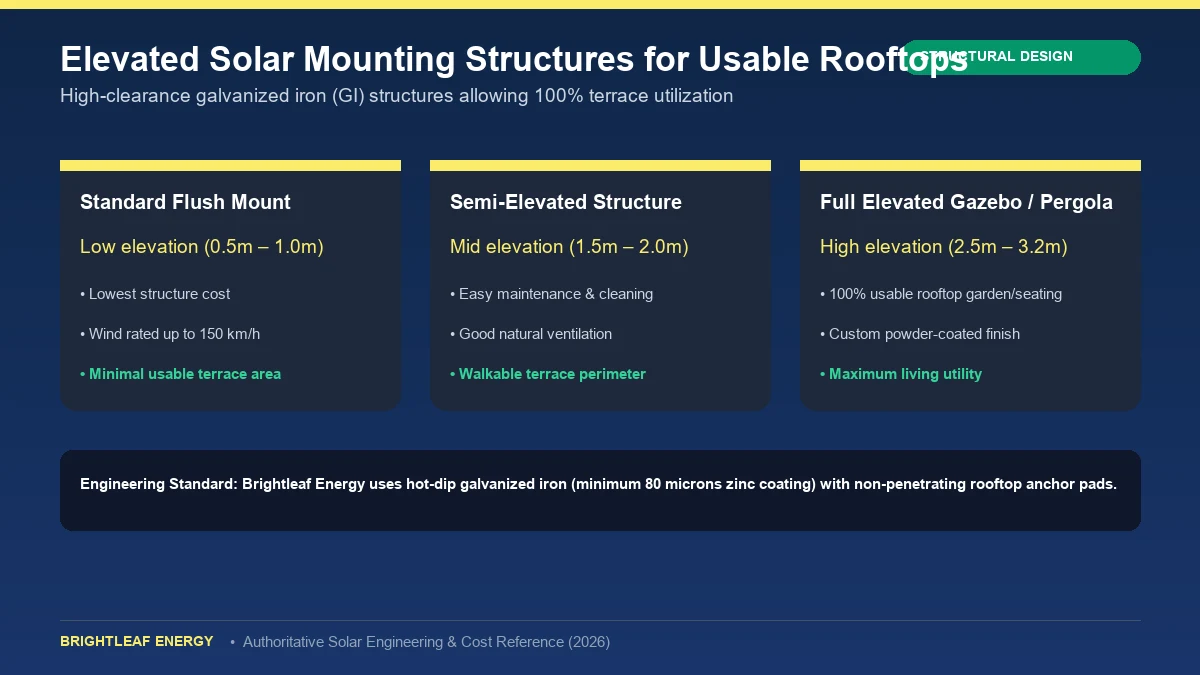
- Mounting structure design, especially for sloped roofs, elevated structures, or areas needing additional civil work
- Length of DC/AC cabling and electrical protection equipment (combiner boxes, earthing, surge protection)
- Rooftop height, accessibility, and whether material needs to be hoisted manually
- Shading conditions that may require micro-inverters or optimisers
- Whether batteries are included
- Net-metering application charges and any DISCOM-related costs
- Warranty terms and after-sales service included by the installer
Because equipment prices, GST rates, and benchmark costs set by implementing agencies change from time to time, we are not going to quote fixed per-kW figures here that could quickly become outdated or misleading. Instead, here is what a transparent quotation should break down for you.
Quotation checklist — ask your installer to itemise
- Cost per solar module and total module cost for the chosen capacity
- Inverter brand, model, and warranty period
- Mounting structure material and type (GI, aluminium, etc.)
- Cabling, earthing, and lightning/surge protection
- Net-metering application and liaison charges, if applicable
- Installation and commissioning labour charges
- Applicable taxes (GST)
- Subsidy amount, if eligible, shown separately from the gross cost
- Warranty coverage — separately for modules, inverter, and workmanship
- Any annual maintenance contract (AMC) terms, if offered
A genuinely useful quotation always follows a technical site visit — rooftop area, shading, electrical load, and your sanctioned connection load all factor into the final price and recommended capacity. Be cautious of quotations given over the phone without any site assessment. See our commercial solar cost per kW breakdown for how the same cost drivers apply at larger capacities.
Solar Subsidy in Delhi: Government Schemes and Eligibility
The central government’s PM Surya Ghar: Muft Bijli Yojana is currently the primary subsidy route for residential rooftop solar across India, including Delhi. It is administered through the national portal pmsuryaghar.gov.in, in coordination with the local DISCOM — in Delhi’s case, BSES Rajdhani, BSES Yamuna, or Tata Power Delhi Distribution Limited (TPDDL), depending on your area.
Broad framework of the scheme
Always confirm current figures on the official portal, as rules and amounts can be revised:
- The scheme is meant for residential consumers installing grid-connected rooftop solar systems. Commercial and industrial consumers are generally not covered under this particular subsidy structure.
- Central Financial Assistance (CFA) is calculated on a per-kW basis and is typically structured in slabs — a higher rate for the first portion of capacity and a lower rate for additional capacity, up to a specified maximum system size and overall subsidy cap.
How to apply, step by step
- Register on the national portal, enter your electricity consumer number and DISCOM details, and apply for feasibility approval for a specific system capacity.
- Once feasibility is approved, install the system through a vendor registered with the scheme — not every solar company is automatically eligible, so check vendor registration status.
- After installation, the DISCOM conducts an inspection and approves net metering.
- A commissioning certificate is generated through the portal.
- Submit your bank account details once commissioning is confirmed.
- The subsidy amount is then disbursed — it is not automatically deducted from the upfront invoice in every case, though some registered vendors may structure the commercial arrangement differently.
Common misunderstandings to be aware of
- Subsidy eligibility is not automatic — it depends on your sanctioned load, available rooftop area, vendor registration, and completion of the DISCOM approval process.
- Subsidy amounts and slab structures have changed over the scheme’s life, so do not rely on a figure you read somewhere months ago without reconfirming it.
- Delhi has, at various points, had its own state-level solar incentives in addition to the central scheme. Policy status can change, so check directly with DERC or your DISCOM for any Delhi-specific provisions currently in force.
- Commercial and institutional properties should not assume residential subsidy terms apply to them; commercial solar investment is typically evaluated purely on electricity bill savings and payback, without CFA-style subsidy support.
Because subsidy terms are subject to revision, treat the figures and slabs you encounter as a starting point for discussion, and always verify current terms on pmsuryaghar.gov.in or with your DISCOM before finalising a system. Our PM Surya Ghar subsidy application guide and Delhi solar policy guide walk through the paperwork in more detail.
How Much Can You Save with Solar Panels in Delhi?
Savings depend on how much electricity your solar system generates versus how much of that generation you actually use or can offset through net metering. Here is the general logic, with an illustrative example — the numbers below are assumptions for explanation purposes, not a promise of actual results.
Factors in the calculation
- Your average monthly electricity consumption (in units/kWh)
- Your DISCOM’s tariff slab and any time-of-day billing provisions
- Expected generation per kW of installed capacity, which varies by season — monsoon and foggy winter days in Delhi typically reduce generation compared to clear summer days
- Roof orientation, tilt, and shading
- How much of the generated solar power is self-consumed versus exported under net metering
- Routine downtime for cleaning, inverter faults, or grid outages
Illustrative example (assumptions stated clearly)
Suppose a household consumes around 400 units a month and installs a 3 kW grid-tied system. If the system generates roughly 4 units per kW per day on average across the year — a commonly cited estimate for northern India, though actual generation varies by rooftop and season — that works out to roughly 360 units a month, which could offset a significant portion of the bill depending on how much is self-consumed versus exported and how net metering is settled by the DISCOM.
Simple payback formula
Simple Payback Period = Net Upfront Investment ÷ Estimated Annual Bill Savings
For example, if the net cost after any eligible subsidy is ₹1,50,000 and the estimated annual savings is ₹25,000, the simple payback works out to 6 years. This is a simplified estimate — it does not account for financing costs, inverter replacement after its typical service life, inflation in electricity tariffs (which could shorten payback), or any drop in panel output over time (which could lengthen it). Treat it as a rough planning number, not a financial guarantee.
Step-by-Step Solar Panel Installation Process in Delhi
While the exact sequence can vary based on approvals and site conditions, most installations in Delhi follow a similar path.
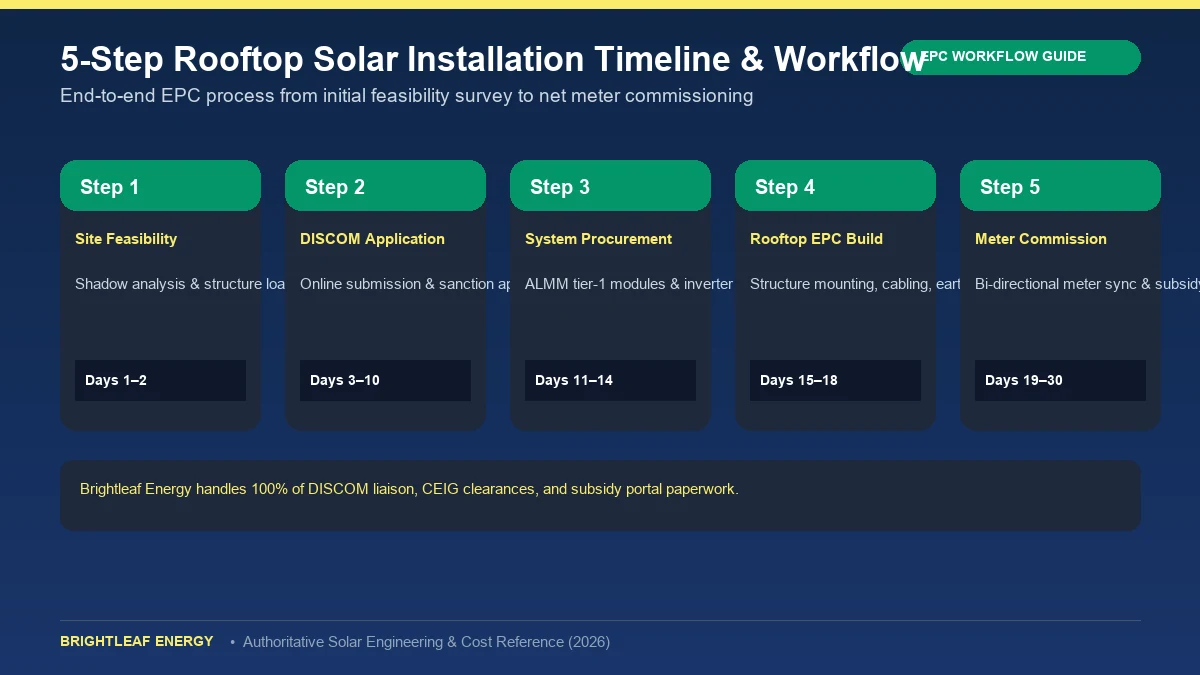
- 1Review your electricity bills to understand your average and peak monthly consumption.
- 2Assess your rooftop — usable area, shading from trees, water tanks, or neighbouring structures, and structural condition.
- 3Determine the right system capacity based on consumption, available space, and budget.
- 4Get a detailed, itemised quotation from one or more installers.
- 5Verify the vendor’s credentials, including scheme registration status if you plan to claim a subsidy.
- 6Submit applications — subsidy portal registration (if applicable) and DISCOM net-metering application.
- 7Install the mounting structure and solar modules on the rooftop.
- 8Install the inverter, DC/AC wiring, earthing, and surge protection.
- 9Complete testing and internal commissioning of the system.
- 10DISCOM inspection and net meter installation, followed by official commissioning.
- 11Ongoing monitoring, maintenance, and warranty support once the system is live.
Depending on DISCOM workload and documentation completeness, the approval and net-metering steps can sometimes take longer than the physical installation itself — it is worth asking your installer for a realistic timeline rather than an optimistic one. Our home solar installation step-by-step guide covers each stage of a residential project in more detail.
How to Choose the Best Solar Installation Company in Delhi
With many vendors offering solar installation in Delhi, it helps to evaluate them on more than just the lowest quoted price.
- Relevant installation experience, particularly with the system type and capacity you need.
- Registration status with PM Surya Ghar or other applicable schemes, if subsidy eligibility matters to you.
- Equipment transparency — ask for specific module and inverter brands, efficiency ratings, and warranty documentation rather than vague assurances.
- Written, itemised quotations that separate equipment, labour, approvals, and taxes.
- Workmanship and electrical safety standards — proper earthing, cable management, and protection equipment matter as much as the panels themselves.
- Structural assessment before quoting, not after signing.
- Support through DISCOM approvals and net metering, since this part of the process can be confusing for first-time applicants.
- After-sales service — who do you call if the inverter throws an error two years from now?
- Honest subsidy guidance rather than promises that every installation automatically qualifies.
- Verifiable reviews or references, where available.
When comparing two quotations, check whether they specify the same module wattage, inverter capacity, and warranty terms before assuming the cheaper one is better value. Our guide on how to choose a solar company near you goes deeper into verification steps.
Is Your Rooftop Suitable for Solar Installation?
Not every rooftop is equally suited to solar, and a proper site assessment should look at:
- Usable rooftop area — actual installable space after accounting for water tanks, staircases, parapets, and setback requirements, not just total roof area.
- Shading from adjacent buildings, trees, or rooftop structures, especially relevant in Delhi’s densely built residential colonies where neighbouring floors can cast shadows for part of the day.
- Orientation and tilt — south-facing roofs generally receive better sun exposure, though east-west orientations can still work with adjusted system design.
- Structural strength — older constructions may need an engineer’s assessment before adding mounting structures and panel weight.
- Access for maintenance and cleaning, and any waterproofing considerations for the roof surface.
- Shared rooftops — in builder floors or multi-unit buildings, you may need written permission from other owners or the housing society before installation.
A one-size “you need X square feet for Y kW” rule is not entirely accurate, since panel dimensions, wattage, and row spacing vary by module technology and installer design — which is exactly why a physical site visit matters more than a generic online estimate. You can book a free rooftop assessment with our engineers to get a site-specific view.
Solar Installation for Homes vs Commercial Properties in Delhi
| Aspect | Residential | Commercial |
|---|---|---|
| Typical consumption pattern | Mixed day/evening usage | Primarily daytime during business hours |
| Subsidy eligibility | Central scheme applicable (subject to conditions) | Generally not covered under residential CFA schemes |
| Roof ownership | Usually owned by applicant | May be owned or leased; permissions may be needed |
| System sizing basis | Household consumption and sanctioned load | Business load profile and peak demand |
| Financial evaluation | Simple payback, long-term bill reduction | Often evaluated on ROI, depreciation benefits, operating cost reduction |
| Billing | Residential tariff slabs | Commercial tariff structure, usually different from residential rates |
Commercial properties — shops, offices, warehouses, small manufacturing units — often get strong value from solar precisely because their consumption aligns with daylight hours, meaning more of the generated power is used directly rather than exported. But commercial system sizing, approvals, and financing considerations are different enough from residential installations that it is worth getting a commercial-specific assessment rather than assuming home-based assumptions apply.
For homeowners, see our residential rooftop solar in Delhi page; for businesses, see commercial solar installation in Delhi.
Solar Panel Maintenance and Lifespan
Solar systems are relatively low-maintenance, but not maintenance-free, particularly in a city like Delhi with seasonal dust and pollution.
- Cleaning: panels accumulate dust, especially during drier months, which can reduce output. Cleaning frequency depends on local conditions.
- Visual inspection: periodically check for physical damage, loose mounting, or cable wear.
- Performance monitoring: most modern inverters offer app-based or portal-based monitoring to track daily generation and flag unusual drops.
- Inverter alerts: pay attention to fault codes or error messages rather than ignoring them.
- Electrical safety checks: periodic checks of earthing and protection equipment, particularly before monsoon season.
- Warranty coverage: module and inverter warranties typically differ in duration and terms — keep documentation handy and understand what is covered.
- Professional servicing: for anything beyond basic cleaning or visual checks, call a qualified technician rather than attempting DIY repairs on electrical components.
We will not quote a specific lifespan figure or guaranteed annual maintenance cost here, since this depends on the equipment brand, installation quality, and site conditions — your installer should be able to share manufacturer-specified warranty and degradation details for the exact products they are proposing.
Common Mistakes to Avoid Before Installing Solar Panels
- Choosing a system capacity without actually reviewing past electricity bills.
- Comparing quotations purely on price, without checking module/inverter specifications.
- Assuming a subsidy is guaranteed before confirming eligibility and vendor registration.
- Ignoring shading patterns or difficult rooftop access that could affect generation.
- Expecting a standard on-grid system to provide backup power during outages.
- Overlooking warranty terms, especially workmanship warranty on installation itself.
- Taking advertised savings figures at face value without checking the underlying assumptions.
- Skipping or delaying the net-metering application, which can delay realising bill savings even after installation is complete.
Frequently Asked Questions About Solar Installation in Delhi
Straight answers to the questions Delhi homeowners and businesses ask most often.
1What is the cost of solar installation in Delhi?
Cost depends on system capacity, equipment quality, and site-specific factors like mounting structure and cabling needs. Rather than a fixed number, ask installers for an itemised quotation based on a rooftop assessment and your consumption pattern.
2Is a subsidy available for rooftop solar in Delhi?
Yes, residential rooftop solar is generally eligible for Central Financial Assistance under PM Surya Ghar: Muft Bijli Yojana, subject to eligibility conditions, vendor registration, and DISCOM approval. Confirm current terms on pmsuryaghar.gov.in.
3What is the cost of a 3 kW solar system in Delhi?
This varies based on module brand, inverter type, and installation complexity. Request a detailed, itemised quotation from two or three registered installers after a site visit, rather than relying on a generic online figure.
4How many solar panels are required for a home?
It depends on panel wattage and your required system capacity. A 3 kW system, for instance, might use anywhere from 6 to 8 panels depending on the wattage rating of each module — your installer can confirm the exact count for the equipment they propose.
5How do I choose the right solar system capacity?
Start with your average monthly electricity consumption and available rooftop area. An installer will typically recommend a capacity that offsets a meaningful share of your usage without exceeding your sanctioned electrical load or rooftop space.
6Can solar panels reduce my electricity bill to zero?
It is possible in some cases depending on consumption, system size, and net-metering settlement, but it is not guaranteed for everyone. Bills depend on your usage pattern, tariff structure, and how much of your consumption the system can realistically offset.
7Do solar panels work during cloudy weather?
Yes, but at reduced output. Panels still generate electricity on cloudy or hazy days, though less than on clear, sunny days — this is factored into annual generation estimates rather than daily guarantees.
8Does a grid-connected solar system work during a power cut?
A standard on-grid system shuts down automatically during a grid outage as a safety measure. If backup during outages matters to you, you would need a hybrid system with battery storage.
9How long does solar installation take?
Physical installation for a typical residential system often takes a few days, but the overall timeline — including subsidy application, DISCOM feasibility approval, and post-installation inspection — can take longer and depends on documentation and DISCOM processing time.
10How can I find a reliable solar installation company in Delhi?
Check installation experience, scheme registration status, equipment transparency, itemised quotations, and after-sales service commitments. Comparing multiple vendors on these parameters, not just price, gives a clearer picture.
Get a Solar Installation Quote in Delhi
If you have read this far, you probably have a fairly good sense of what goes into a solar installation decision — system type, cost drivers, subsidy eligibility, and what to look for in an installer. The next practical step is usually a rooftop assessment, since every property’s consumption pattern, roof condition, and shading situation is a little different.
Brightleaf Energy can walk you through a site assessment, explain which system type and capacity suits your electricity usage, and provide an itemised quotation that accounts for applicable subsidy eligibility. There is no harm in getting an assessment done before deciding whether solar makes sense for your property this year.
Sources & Official References
- PM Surya Ghar: Muft Bijli Yojana — official national portal
- Ministry of New and Renewable Energy (MNRE), Government of India
- Delhi Electricity Regulatory Commission (DERC)
- BSES Rajdhani / BSES Yamuna and Tata Power Delhi Distribution Limited (TPDDL) consumer portals for Delhi DISCOM-specific net-metering procedures.
Subsidy amounts, slab structures, benchmark costs, and net-metering rules are subject to revision. Confirm current terms with the official portals above and your DISCOM before finalising a system.
Related Solar Knowledge
The 8-step process from load calculation and site survey to DISCOM commissioning.
Delhi-specific policy, generation-based incentives and net metering explained.
1 kW to 10 kW price breakdown, subsidy impact and 25-year payback math.
What battery backup actually costs and how many hours it can run your home.