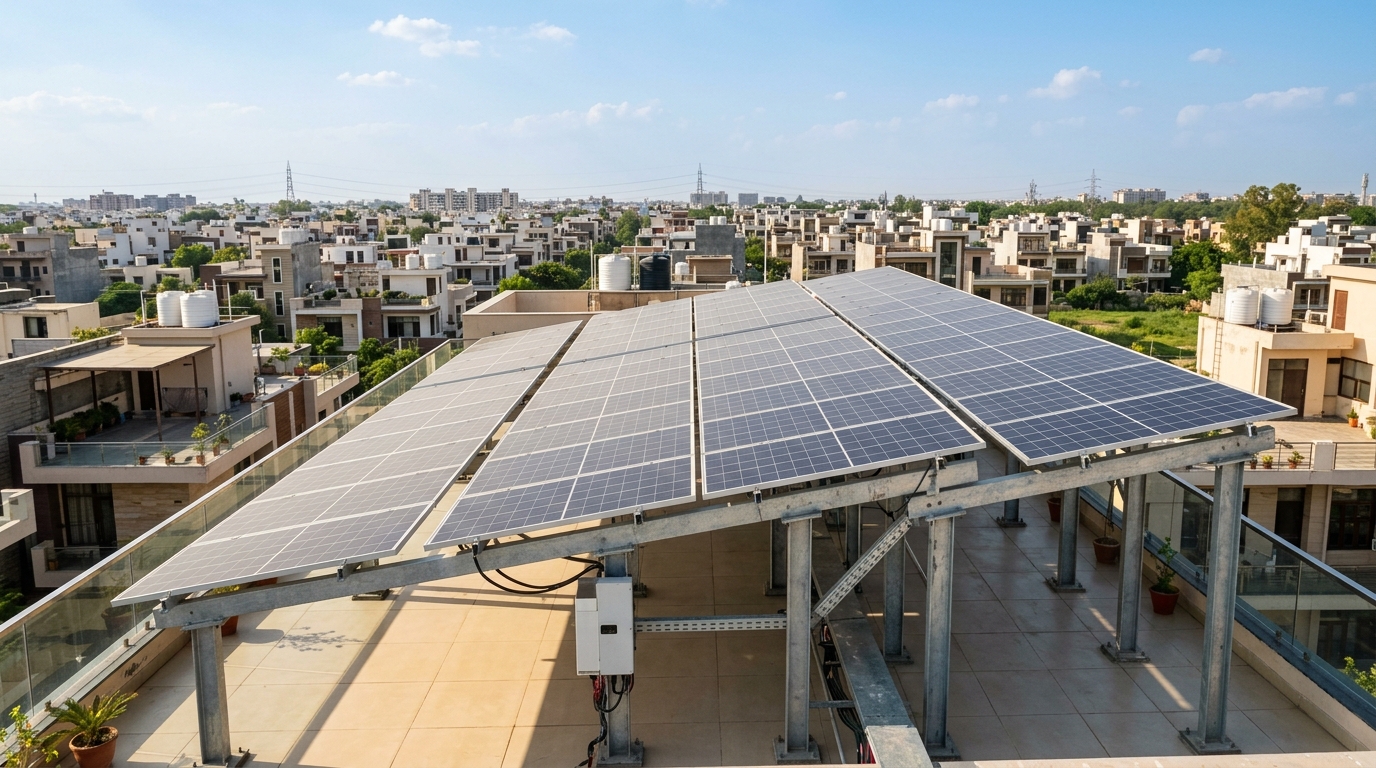
In 2026, the Government of Delhi combined its state solar policy with the Central Government's PM Surya Ghar: Muft Bijli Yojana to create a triple-benefit framework:
Direct transfer to bank account for 1kW–3kW rooftop systems.
Additional capital support bridging the remaining consumer share.
Cash bonus credited for every single solar unit generated.
1. Delhi Solar Policy 2026: Key Mandates & Vision
The National Capital Territory of Delhi faces a unique energy landscape. With extreme summer peak loads surpassing 8,600+ MW and electricity consumption growing steadily across residential colonies, relying exclusively on coal-fired transmission grids from neighboring states is both financially burdensome and ecologically unsustainable.
To address this challenge, the Delhi Government formally notified the revised Delhi Solar Policy 2026. The policy sets an aggressive target of achieving 4,500 MW of installed solar capacity by 2027 (comprising 750 MW of rooftop solar within the city and 3,750 MW of utility-scale procurement).
Crucially, the policy shifts Delhi's energy paradigm from temporary consumable tariff subsidies to permanent wealth-generating distributed energy assets for homeowners. Rather than spending state revenues solely on monthly DISCOM bill reimbursements, the government incentivizes citizens to produce their own clean power right on their rooftops.
Whether you are evaluating a residential solar installation in Delhi for an independent villa, or installing commercial rooftop solar in Delhi to offset commercial grid tariffs, selecting an empanelled EPC partner from our best solar company in Delhi NCR guide ensures fast-tracked net-metering synchronization with BSES Rajdhani (BRPL), BSES Yamuna (BYPL), and Tata Power (TPDDL).
Consumers using up to 400 units/month who switch to rooftop solar pay ₹0 electricity bills, regardless of future tariff hikes by the Delhi Electricity Regulatory Commission (DERC).
A ₹3.00/unit Generation-Based Incentive paid directly to the homeowner for 5 years, providing monthly passive income on top of 100% electricity savings.
Enables DDA flat owners, multi-story floors, and Group Housing Societies (GHS) without private roofs to share terrace solar power proportionally.
Unified portal integration with BRPL, BYPL, and TPDDL ensuring net metering clearance within 15 to 30 calendar days.
2. The 400-Unit Threshold & Zero-Bill Mathematics
Many Delhi residents ask: "Why is 400 units specifically highlighted in the policy?"
Under Delhi's domestic electricity tariff structure, households consuming 0 to 200 units received a 100% subsidy (zero bill), while those consuming 201 to 400 units received a 50% discount (capped at ₹800). However, during scorching summers when air conditioners run, consumption routinely jumps from 200 units to 350–450 units, instantly pushing families into commercial-level tariff slabs where bills skyrocket to ₹3,000–₹6,000+ per month.
The Delhi Solar Policy 2026 creates a permanent escape from this tariff trap. By sizing a rooftop solar system between 2kW and 3kW, a home generates between 240 and 390 units of pure green power every month.
| System Size | Monthly Gen | Estimated Cost | Central Subsidy | Delhi Subsidy | 5-Yr GBI Bonus | Net Lifetime Cost |
|---|---|---|---|---|---|---|
| 1 kW System | ~120 - 130 Units | ₹65,000 - ₹75,000 | ₹33,000 | ₹2,000 | + ₹21,600 | ~₹8,400 (Effectively ₹0) |
| 2 kW System (Recommended) | ~240 - 260 Units | ₹1,25,000 - ₹1,40,000 | ₹66,000 | ₹4,000 | + ₹43,200 | ₹0 (Net Profitable!) |
| 3 kW System (Best Value) | ~360 - 390 Units | ₹1,75,000 - ₹1,95,000 | ₹78,000 | ₹6,000 - ₹10,000 | + ₹64,800 | ₹0 (Earns +₹15,000 Surplus) |
| 5 kW System | ~600 - 650 Units | ₹2,80,000 - ₹3,10,000 | ₹78,000 (Max) | ₹10,000 (Max) | + ₹72,000 (@₹2/u) | ~₹1,20,000 (Payback in 2.8 Yrs) |
*Notes: All pricing figures reflect standard ALMM-approved Mono PERC/TOPCon modules with grid-tied inverters and turnkey net metering installation. GBI payouts calculated assuming average 4.0 Peak Sun Hours/day in Delhi over 5 years.
3. The Dual Subsidy Stack: Central + State Capital Incentives
In Delhi, homeowners receive two distinct layers of capital subsidies, which are credited directly to their verified bank accounts via Direct Benefit Transfer (DBT). You can also review our step-by-step national PM Surya Ghar application guide for national portal registration protocols:
PM Surya Ghar Central Subsidy
- 1 kW Capacity: ₹33,000 fixed central assistance.
- 2 kW Capacity: ₹66,000 fixed central assistance.
- 3 kW to 10 kW: ₹78,000 maximum capped central assistance.
Disbursed directly by the Ministry of New and Renewable Energy (MNRE) within 30 days of net meter commissioning.
Delhi State Government Top-Up
- State Capital Grant: ₹2,000 to ₹3,000 per kW up to a maximum cap of ₹10,000 per consumer.
- Zero State Taxes: Complete exemption of electricity duty, inspection cess, and municipal surcharges on solar-generated units.
- Accelerated Feasibility: Priority clearance through DISCOM solar desks.
Claimed simultaneously through the single-window Delhi Solar Portal during net metering registration.
4. Generation-Based Incentive (GBI): Earn ₹3.00/kWh in Cash
What truly sets Delhi's solar policy apart from every other Indian state is the Generation-Based Incentive (GBI). While standard net metering only deducts units from your monthly bill, GBI pays you pure cash for every single unit your rooftop panels generate, regardless of whether you consume that electricity inside your home or export it to the grid.
Designed specifically for middle-class and 400-unit households to achieve immediate cash profitability.
Ideal for larger independent homes, duplexes, villas, and RWAs with high AC loads.
The solar generation meter records total gross generation monthly. The DISCOM automatically credits the GBI amount (Units Generated × ₹3.00) against any minor fixed charges. Any surplus credit balance is directly transferred to your registered bank account bi-annually or annually via DBT.
• Average Daily Generation: 12 units/day
• Monthly Generation: 360 units
• Monthly GBI Earnings: 360 units × ₹3.00 = ₹1,080 / month
• Annual GBI Income: ₹1,080 × 12 = ₹12,960 / year
• Total 5-Year GBI Cash Collected: ₹12,960 × 5 = ₹64,800 pure cash bonus!
5. Delhi DISCOM Net Metering Guidelines (BRPL, BYPL, TPDDL)
Solar net metering in Delhi is governed by the Delhi Electricity Regulatory Commission (DERC) Net Metering Regulations. A bidirectional digital meter replaces your old single-phase or three-phase meter, recording both imported power from the grid and exported solar surplus.
Serves Saket, Dwarka, Vasant Kunj, Janakpuri, Hauz Khas, Punjabi Bagh & surrounding sectors.
Serves Laxmi Nagar, Mayur Vihar, Preet Vihar, Shahdara, Daryaganj & East Delhi colonies.
Serves Rohini, Pitampura, Model Town, Shalimar Bagh, Civil Lines & Narela.
- 100% Transformer Capacity: The earlier 30% cap on distribution transformer capacity has been relaxed up to 100%, eliminating historical grid saturation delays.
- Sanctioned Load Matching: Solar capacity is permitted up to 100% of your sanctioned connected load (e.g., a 3kW load allows up to 3kW solar). Load enhancement can be applied online simultaneously.
- Annual Settlement Roll-Over: Excess exported solar units are banked month-to-month and settled annually in October/April cycle at average power purchase cost (APPC).
6. Step-by-Step Application & DBT Subsidy Workflow
Applying for solar subsidies in Delhi is streamlined through the National Portal with automated DISCOM synchronization. When you partner with Brightleaf Energy, our engineering team manages all technical filings end-to-end:
Our solar engineers inspect your terrace, measure shadow-free dimensions, verify load requirements, and draft a 3D generation layout with exact subsidy calculations.
Register on pmsuryaghar.gov.in using your active Delhi DISCOM (BRPL/BYPL/TPDDL) CA Consumer Number and mobile number. Select Brightleaf Energy as your empaneled vendor.
The DISCOM automatically validates your connected load and issues online technical feasibility approval within 3 to 7 working days.
Brightleaf Energy installs ALMM-certified TOPCon/Mono PERC modules, smart inverters, lightning arrestors, and dual-pole chemical earthing within 48 to 72 hours.
DISCOM officials perform joint site verification, install the bidirectional net meter, and issue the formal System Commissioning Certificate.
Bank account details and cancelled cheque are verified. The Central Subsidy (₹33,000–₹78,000) and State Grant are credited directly into your bank account within 30 days.
7. Eligibility Criteria & Mandatory Document Checklist
To qualify for the combined PM Surya Ghar and Delhi State solar subsidy package, ensure you have the following prerequisites ready:
- Must be an Indian citizen residing in NCT Delhi.
- Must own residential property (freehold house, builder floor roof rights, or RWA common terrace).
- Have an active domestic electricity connection with BRPL, BYPL, or TPDDL without outstanding dues.
- Have at least 100 sq.ft of shadow-free rooftop area per kW of desired capacity.
- Electricity Bill: Latest bill showing CA Consumer Number and sanctioned load.
- Identity Proof: Aadhaar Card (linked to the applicant's mobile number).
- Banking Proof: Cancelled cheque or bank passbook copy showing IFSC and Account Number.
- Property Document: House tax receipt, sale deed copy, or registry page.
8. 10-Year & 25-Year Financial ROI & Savings Model
Solar panels are not an expenditure—they are a high-yielding wealth preservation asset. Comparing the Levelized Cost of Electricity (LCOE) of rooftop solar against grid power reveals why solar is the safest financial investment in Delhi today:
Per unit (and inflates ~4–6% annually).
Per unit levelized generation cost.
With full GBI + Subsidies applied.
After recovering capital in under 2 years, your family enjoys 23+ continuous years of completely free, clean electricity shielded from inflation.
For a complete technical and financial comparison of different rooftop capacities, explore our comprehensive guide on 3kW, 5kW & 10kW solar system costs in India or examine the 10-year ROI comparison between solar and grid tariffs.
9. Virtual Net Metering (VNM) for Delhi Apartments & RWAs
Over 45% of Delhi's urban population lives in multi-story apartments, DDA housing complexes, cooperative societies, or builder floors where individual terrace ownership is divided. Under conventional solar frameworks, apartment dwellers were excluded from solar benefits.
The Delhi Solar Policy 2026 resolves this through two groundbreaking regulatory mechanisms:
Virtual Net Metering (VNM)
A single large solar power plant is installed on a shared terrace or open community shed. The generated units are digitally divided among participating flat owners based on their subscribed equity ratio and directly deducted from each individual flat's electricity bill.
Group Net Metering (GNM)
Surplus solar power generated from one consumer meter (e.g., society clubhouse or water pumping station) can be offset against other service meters owned by the same entity across different locations in Delhi.
RWAs and Housing Societies installing solar for common services (lifts, water motors, corridor lighting, EV chargers) also receive specialized capital subsidies and GBI at ₹2.00/kWh up to 500kW capacity.
10. Why Choose Brightleaf Energy as Your Delhi Solar Partner
Installing a rooftop solar plant is a 25-year engineering commitment. At Brightleaf Energy, we bring end-to-end EPC precision to every residential and commercial rooftop in Delhi NCR:
Only ALMM-listed Mono PERC and TOPCon N-Type bifacial solar panels with 25-year performance warranties.
Zero-error paperwork, complete DISCOM net metering liaison, and verified DBT subsidy release directly to your account.
Hot-dip galvanized mounting structures engineered for 150 km/h winds, preserving your usable terrace space.
Ready to Slash Your Delhi Power Bill to Functional ₹0?
Get an instant 3D rooftop survey, shadow analysis, and customized PM Surya Ghar + Delhi State Subsidy proposal from Brightleaf Energy engineers.
11. Frequently Asked Questions (FAQ)
1.Does 'Free Solar Panels' mean Delhi residents pay literally ₹0 upfront?
Under the Delhi Solar Policy 2026 combined with PM Surya Ghar Muft Bijli Yojana, residential consumers with monthly electricity consumption of up to 400 units who install a 1kW to 3kW system can achieve a functional 100% cost recovery. While a nominal initial contribution or low-interest collateral-free loan (available at ~6-7% through nationalized banks) is initiated, the combined Central Financial Assistance (up to ₹78,000), Delhi State Capital Subsidy (₹2,000–₹3,000/kW), and the Generation-Based Incentive (GBI of ₹3.00/kWh for 5 years) completely offset the capital expense, rendering the net lifetime expenditure at ₹0 or even net-positive.
2.What is the Generation-Based Incentive (GBI) under the Delhi Solar Policy 2026?
The Delhi Government provides a Generation-Based Incentive (GBI) of ₹3.00 per kilowatt-hour (kWh) for residential solar systems up to 3kW, and ₹2.00 per kWh for systems between 3kW and 10kW. This incentive is credited directly into the consumer's bank account or adjusted against monthly electricity bills for 5 continuous years from the date of commissioning, earning homeowners ₹12,000 to ₹18,000+ per year in cash bonuses.
3.How does the subsidy stack work between PM Surya Ghar and Delhi Government?
The subsidy is dual-layered: 1) Central Government (PM Surya Ghar): ₹33,000 for 1kW, ₹66,000 for 2kW, and ₹78,000 for 3kW or higher. 2) Delhi State Government: An additional state capital top-up of ₹2,000 to ₹3,000 per kW (up to ₹10,000 maximum). Combined, a 3kW system receives ₹88,000+ in direct capital subsidies, plus 5 years of GBI cash incentives.
4.Can tenants in Delhi avail the solar subsidy for 400 unit households?
No. The PM Surya Ghar and Delhi State Solar Policy subsidies require property ownership or explicit written authorization and registered lease documents from the building owner. The electricity meter CA (Consumer Account) number must be linked with the property owner's Aadhaar and bank details for Direct Benefit Transfer (DBT).
5.Which DISCOMs support solar net metering in Delhi?
All three major Delhi power distribution companies support online net metering: BSES Rajdhani Power Limited (BRPL), BSES Yamuna Power Limited (BYPL), and Tata Power Delhi Distribution Limited (TPDDL). Under DERC 2026 regulations, net meters must be energized within 15 to 30 days of installation.
6.How much rooftop area is required for a 3kW solar system in Delhi?
A standard 3kW residential rooftop solar power system in Delhi requires approximately 250 to 300 square feet of shadow-free, south-facing roof area. With modern high-efficiency TOPCon or Mono PERC bifacial solar panels (550Wp+), the space requirement can be as compact as 220 to 250 square feet.
7.What happens if my household consumes more than 400 units in summer due to ACs?
The 400-unit threshold determines baseline zero-bill eligibility. If your consumption surges to 600–800 units during peak summer months, your rooftop solar plant continues generating free power (e.g., a 5kW system generates ~600–700 units/month), offsetting the high tariff slab (₹6.50–₹8.50/unit) and saving you 70% to 90% on your total billing.
8.How do apartment owners in DDA flats or Group Housing Societies (GHS) get solar in Delhi?
Delhi's policy uniquely features Virtual Net Metering (VNM) and Group Net Metering (GNM). Resident Welfare Associations (RWAs) or apartment owners can install a centralized solar system on the shared society terrace, and the generated solar credits are proportionally distributed directly to individual flat electricity meters.
9.How long does it take for the subsidy money to reach my bank account via DBT?
Once the solar plant is installed, the DISCOM installs the bidirectional net meter, and the joint inspection report is uploaded on the PM Surya Ghar National Portal, the Central Financial Assistance is directly credited to your linked bank account via DBT within 30 days.
10.What equipment warranties are provided with a Brightleaf Energy installation?
Brightleaf Energy installs ALMM-approved Tier-1 Mono PERC / TOPCon solar panels with a 25-year linear performance warranty and 10–12 year product warranty, alongside 5–10 year warranties on grid-tied smart inverters, hot-dip galvanized mounting structures engineered for 150 km/h wind loads, and 5 years of complimentary operations & maintenance (O&M).
Explore Related Solar Guides & Insights
Compare Tata Power, Waaree, Adani, and Vikram Solar TOPCon modules for NCR homes.
Complete guide to commercial rooftop solar EPC, accelerated depreciation & 90% bill savings.
Everything you need to know about national PM Surya Ghar subsidy tiers up to ₹78,000.
Detailed pricing, daily generation benchmarks & 25-year return on investment.