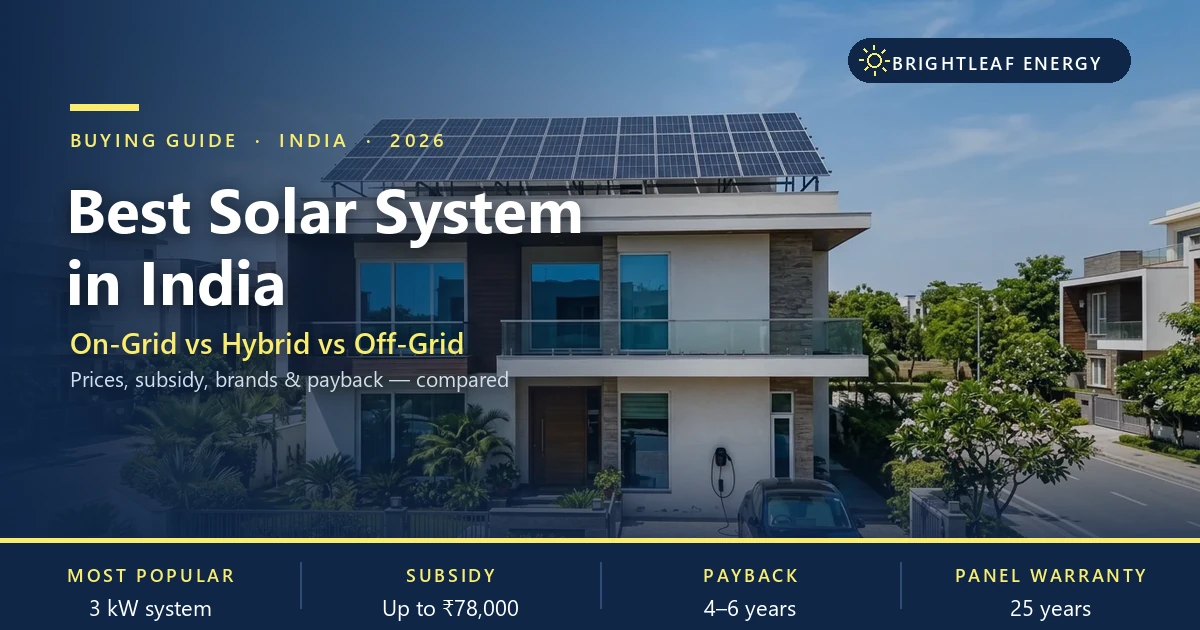
If you are searching for the best solar system in India, you are not alone. With electricity tariffs rising across states and frequent power cuts in many cities, more Indian homeowners are switching to solar energy to cut monthly bills and gain energy independence.
But with dozens of panel brands, three system types, and varying state-level subsidies, choosing the best solar system in India for your home can feel overwhelming. This guide breaks down everything you need to know: system types, real 2026 pricing, top solar panel brands, government subsidies, and how to pick the right size for your house.
Whether you live in Delhi, Mumbai, Bengaluru, or a smaller city, you will find a clear, step-by-step path to installing the best solar system in India for your needs.
What Is a Solar System?
A solar system (or solar power system) converts sunlight into electricity using photovoltaic (PV) panels, an inverter, and mounting hardware. For Indian homes, the electricity generated can either run your appliances directly, charge batteries for backup, or be exported to the grid through net metering.
Capture sunlight and generate DC electricity.
Converts DC to AC for home appliances.
Fixes panels securely to your rooftop.
Tracks units exported to the grid.
Types of Solar Systems in India
Before choosing the best solar system in India, you must decide which system type fits your home, location, and budget.
On-Grid Solar System
Connects directly to the utility grid via a bidirectional net meter. Automatically exports excess solar power to earn bill credits.
Hybrid Solar System
Combines on-grid net metering with a smart battery bank. Powers critical appliances during power cuts.
Off-Grid Solar System
Operates completely detached from the grid using battery banks. For remote areas without grid power.
Which Solar System Is Best for Your Home?
| Feature | On-Grid | Off-Grid | Hybrid |
|---|---|---|---|
| Battery Required | No | Yes | Yes |
| Grid Connection | Yes | No | Yes |
| Net Metering | Yes | No | Yes |
| Power During Outage | No | Yes | Yes |
| Relative Cost | ₹ | ₹₹₹ | ₹₹₹₹ |
| Best For | Urban homes with stable grid | Rural / remote homes | Metro homes wanting backup |
Verdict: For most urban Indian households, the best solar system in India is a 3 kW–5 kW on-grid system because it offers the fastest ROI through net metering and lower upfront cost.
Top Solar Panel Brands in India (2026)
When evaluating the best solar system in India, panel quality matters more than anything else. These are the leading solar panel brands India trusted by installers and homeowners:
| Brand | Panel Type | Performance Warranty | Known For |
|---|---|---|---|
| Tata Power Solar | Mono PERC / Bifacial | 25 years | Pan-India service network, bank financing |
| Adani Solar | Mono PERC | 25 years | Large-scale manufacturing, competitive pricing |
| Vikram Solar | Mono PERC / Bifacial | 25 years | High efficiency, export-quality panels |
| Waaree Energies | Poly / Mono | 25 years | One of India's oldest solar manufacturers |
| Loom Solar | Mono PERC | 25 years | Residential focus, easy EMI options |
Expert tip: Always ask for the panel's datasheet and verify the serial number on the manufacturer's website before installation.
Solar System Price in India (2026 Estimates)
The solar panel price in India and full system cost depend on capacity, panel brand, and whether you include batteries.
| System Size | Estimated Cost (On-Grid) | Suitable For |
|---|---|---|
| 1 kW | ₹60,000 – ₹80,000 | Small apartments, 1–2 people |
| 3 kW | ₹1,50,000 – ₹2,00,000 | 2–3 BHK homes |
| 5 kW | ₹2,40,000 – ₹3,20,000 | Large homes, small offices |
Note: Prices are indicative and vary by city, brand, and installer. The solar panel installation cost in India typically includes panels, inverter, mounting structure, wiring, and net metering charges.
Government Subsidies & Schemes (India)
The government supports residential solar adoption through the PM Surya Ghar Yojana (Rooftop Solar Programme). Under this government solar scheme in India, residential consumers can receive:
Up to ₹30,000 per kW subsidy
Up to ₹78,000 total subsidy
Additional state-level incentives vary
Capped at 10 kW for residential
Subsidy amounts vary by state and are disbursed through state nodal agencies after successful installation and inspection. Check your state's renewable energy portal or ask your installer to apply on your behalf.
How to Choose the Best Solar System for Your Home
Look at your latest bill for average monthly units (kWh). A 1 kW solar system generates about 4–5 units per day in most Indian cities.
You need approximately 80–100 sq. ft. of shadow-free rooftop space per 1 kW of solar panels. South-facing roofs perform best in India.
Reliable grid → On-grid. Frequent power cuts → Hybrid. No grid → Off-grid.
Contact at least three solar panel dealers in India and compare panel brand, inverter warranty, installation cost, and after-sales service.
Confirm whether your state offers additional subsidies on top of the central PM Surya Ghar scheme.
Installation Process: What to Expect
Technician checks roof structure, shadow, and orientation.
Custom layout and inverter sizing.
Itemized cost, timeline, warranty terms.
Usually completed in 1–3 days for residential systems.
Installer coordinates with DISCOM (for on-grid systems).
System turned on and performance verified.
Maintenance & Warranty
Solar systems require minimal maintenance:
- Panel cleaning: Every 2–4 weeks (dusty regions) or monthly.
- Inverter check: Once a year.
- Battery maintenance (if hybrid): Check water levels every 3–6 months for lead-acid batteries.
25 years performance, 10–12 years product
5–10 years
10–25 years
1–5 years (varies by installer)
Frequently Asked Questions
Answers to common questions about the best solar system in India.
1How much does the best solar system in India cost for a 3-bedroom house?
For a typical 3 BHK home, a 3 kW to 5 kW on-grid solar system in India costs between ₹1,50,000 and ₹3,20,000 before subsidies. After applying central and state subsidies, your out-of-pocket cost can drop by ₹40,000–₹70,000.
2Can I run an air conditioner on solar power?
Yes, but you need sufficient capacity. A 1.5-ton AC consumes about 1.5 units per hour. A 5 kW solar system can comfortably run ACs during daylight hours if designed correctly.
3What is the payback period for solar panels in India?
Most residential solar systems recover their cost in 4 to 6 years through electricity savings. With net metering, payback can be even shorter in states with high tariffs.
4Which is the best solar company in India for home installation?
There is no single best company — it depends on your city and budget. Tata Power Solar, Adani Solar, and Loom Solar have strong pan-India networks, but local installers may offer better service in smaller towns. Always check references and past installations.
5Do solar panels work during monsoon or cloudy days?
Yes, but at reduced efficiency (typically 10–25% of rated capacity). They still generate power from diffuse sunlight.
6Is the best solar system in India eligible for government subsidy?
Yes. Under the PM Surya Ghar Yojana (Rooftop Solar Programme), residential consumers can receive up to ₹78,000 for systems of 3 kW to 10 kW, with additional state-level subsidies varying by state.
Conclusion: Start Saving with Solar Today
Choosing the best solar system in India comes down to matching your home's energy needs, rooftop space, and budget with the right system type and panel brand. For most urban homeowners, a 3 kW–5 kW on-grid system from a reputable brand offers the best balance of savings, reliability, and government subsidy eligibility.
With electricity prices unlikely to fall, installing solar today is one of the smartest long-term investments an Indian homeowner can make. Start by checking your latest electricity bill, measuring your shadow-free rooftop space, and requesting quotes from at least three certified installers in your city.
Sources & Official References
- PM Surya Ghar: Muft Bijli Yojana — official national portal
- Ministry of New and Renewable Energy (MNRE), Government of India
Subsidy amounts, tariffs, and scheme details are subject to change and site/DISCOM approval. Verify against the official portals above before relying on any figure.
Related Solar Knowledge
Detailed breakdown of residential solar pricing, sizing, and government subsidies across Indian states.
Step-by-step guide to claim PM Surya Ghar rooftop solar subsidy in India.
Compare system types, battery backup needs, and net metering rules for Indian homes.
Compare Tata, Waaree, Adani & Vikram Solar — technologies, warranties & prices.