How Much Does a 3kW, 5kW & 10kW Solar System Cost for Home in India?
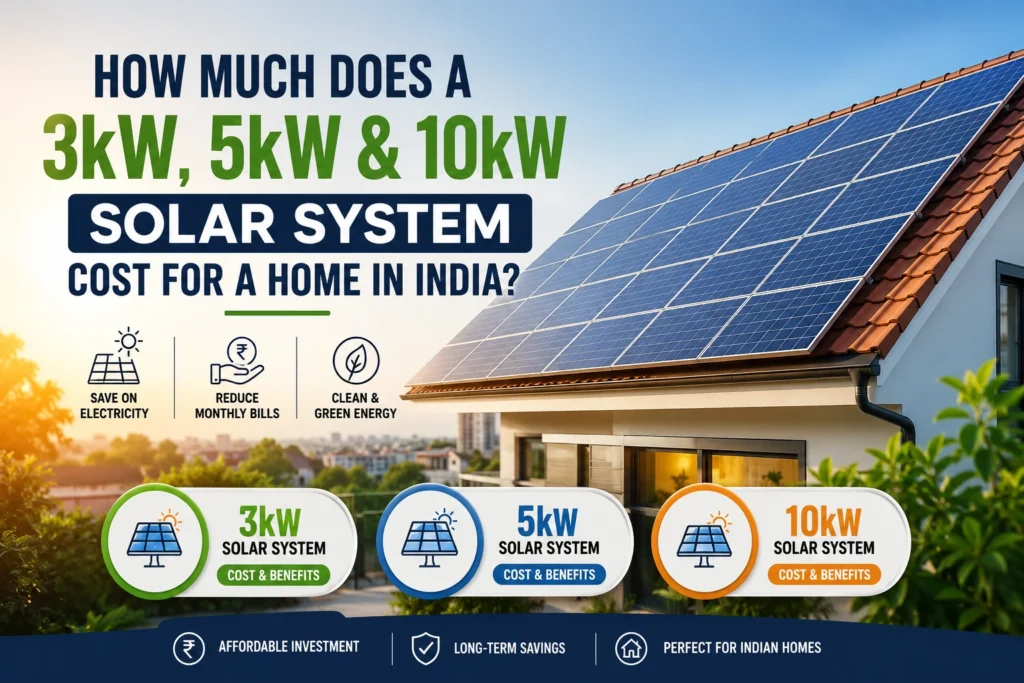
Electricity bills in India have been increasing annually, making rooftop solar one of the best investments for homeowners. Regardless of whether you have an individual house, villa, farmhouse, or residential building, you will be able to save a lot of money by reducing monthly electricity bills with solar systems.
Some of the frequently asked questions include: what is the solar installation cost for home in India?
This will be dependent on various elements like system size, type of solar panels, inverter types, roof structures, location, labour costs, and subsidies available. While a solar system that is 3kW would cost less, a 10kW solar system would be more expensive, as it is meant for larger buildings that consume more electricity.
In 2026, the average home solar system cost in India is about ₹60,000 – ₹70,000 per kW before any subsidy. Some government schemes like PM Surya Ghar Muft Bijli Yojana are encouraging people to adopt renewable energy sources.
In this blog, we will explain the cost of 3kW, 5kW, and 10kW solar systems, available subsidies, expected savings, and how to choose the right solar setup for your home.
What Is the Solar Cost for Home in India?
The average rooftop solar price in India depends on system size, component quality, and subsidy eligibility.
| Solar System Size | Average Cost Before Subsidy | Estimated Subsidy | Approximate Final Cost |
|---|---|---|---|
| 3kW | INR 1.8 Lakh to INR 2.1 Lakh | Up to INR 78,000 | INR 1.02 Lakh to INR 1.32 Lakh |
| 5kW | INR 3 Lakh to INR 3.5 L | Up to INR 78,000 | INR 2.22 Lakh to INR 2.72 Lakh |
| 10kW | INR 6 Lakh to INR 7 Lakh | Up to INR 78,000 | INR 5.22 Lakh to INR 6.22 Lakh |
Subsidy amounts are subject to government guidelines and eligibility criteria.
For most homeowners, a rooftop solar system pays for itself within 4–6 years while continuing to generate electricity for more than 25 years.
Factors That Affect Home Solar System Cost
Many homeowners are surprised to receive different quotations for the same solar system capacity. This happens because several variables influence the final project cost.
Solar Panel Technology
The selection of the right solar panel plays an important role in determining efficiency, energy production, and even the price of the entire project.
Mono PERC Solar Panels
Mono PERC panels are some of the most commonly installed solar panels in India. Benefits include: efficiency in terms of performance, reliability, affordable pricing, and are ideal for rooftop use in residences.
TOPCon Solar Panels
TOPCon technology is increasingly gaining popularity due to high efficiency and heat resistance. Benefits include: high energy production, low-light performance capabilities, long-lasting stability, and performance in India’s climatic conditions.
Bifacial Solar Panels
Bifacial panels produce electricity from both sides of the solar modules. Benefits include: high energy production capabilities, reflective performance, and saving money in the long run. Although advanced technology costs more, it provides greater results.
Inverter Type
Inverter technology is used to convert the direct current produced by solar panels to an alternate form of current.
String Inverters
String inverters are widely employed in residential solar energy applications due to their economic viability, dependability, and ease of maintenance.
Micro Inverter
Micro inverters are mounted on individual panels. Advantages include effective shading control, increased system performance, and panel-level monitoring.
Hybrid Inverter
Battery and backup energy systems can be integrated using hybrid inverters. Ideal for frequent power outages, independence from conventional power sources, and potential battery upgrades in the future. Hybrid inverters, owing to their increased capabilities, usually command higher prices than regular string inverters.
Roof Type and Installation Complexity
The construction and state of the roof play an important role in determining the cost of installation. Some factors affecting price are: RCC roof vs Tin shed roof, Height of roof, Access, Stability, Shadow study, and Mounting. Properties that require extra engineering and mounting structures usually come at a higher price.
State-Wise Labor Costs
Labor charges and logistics vary across India. Installation costs may differ slightly between Delhi NCR, Maharashtra, Gujarat, Karnataka, Telangana, and Rajasthan. These differences are usually caused by local labor rates, transportation expenses, and permit requirements.
Solar Subsidy Eligibility
Government subsidy programs could considerably lower the cost of solar systems. Eligibility will be based on: Property owners in residence, MNRE approved system installation, Adherence to PM Surya Ghar specifications, and System connectivity to the grid. Individuals qualifying for government subsidies will be able to save considerable amounts from their initial investment costs.
3kW Solar System Cost for Home
A 3 kW solar power system is one of the most common selections made by Indian homeowners who want to save money on their utility bills without spending too much money up front. It provides a balance among these aspects.
Who Should Install a 3kW Solar System?
The installation of a 3 kW Solar Power system is perfect for families requiring 250 to 400 units of electricity monthly. Such systems find application in: 2 BHK & 3 BHK apartments, Small independent houses, Homes with moderate usage of electricity, Homes which require simple appliances and air conditioners.
How Many Appliances Can Run on a 3kW Solar System?
A properly designed 3kW solar system can comfortably power: 8–10 LED lights, 4–5 ceiling fans, 1 refrigerator, 1 television, 1 washing machine, 1 water pump, and 1 air conditioner (limited usage). Actual performance depends on sunlight availability, appliance efficiency, and daily usage patterns.
How Much Electricity Does a 3kW Solar System Generate?
| Generation Period | Estimated Output |
|---|---|
| Per Day | 12-15 units |
| Per Month | 360-450 units |
| Per Year | 4,300 – 5,400 units |
This is generally sufficient to offset a significant portion of a typical household’s electricity consumption.
3kW Solar System Cost Breakdown
The average 3kW solar system cost in India ranges between ₹1.8 lakh and ₹2.1 lakh before subsidy.
| Component | Estimated Cost |
|---|---|
| Solar Panels | INR 1,00,000 to INR 1,20,000 |
| Solar Inverter | INR 25,000 to INR 35,000 |
| Mounting Structure | INR 15,000 to INR 20,000 |
| Wiring and Safety | INR 10,000 to INR 15,000 |
| Installation Charges | INR 15,000 to INR 20,000 |
Final pricing may vary based on panel brand, inverter type, roof structure, and installation complexity.
What Subsidy Is Available for a 3kW Solar System?
As per the PM Surya Ghar Muft Bijli Yojana scheme, those who qualify can avail themselves of subsidies from the government for setting up rooftop solar projects. These subsidies include: Reducing initial capital costs, Improving financial accessibility, Enhancing returns on investments, and Lowering payback periods. Subsidy amounts depend upon government policies.
How Much Can You Save With a 3kW Solar System?
Most homeowners can reduce their electricity bills by 60% to 90%, depending on usage patterns.
Estimated Savings:
Monthly Savings: ₹2,500–₹4,500
Annual Savings: ₹30,000–₹54,000
25-Year Savings: ₹7.5 lakh–₹13 lakh+
What Is the Payback Period of a 3kW Solar System?
On average, the payback period is 4 to 6 years. Following reimbursement for the installation costs, electricity will be practically free for the rest of the life of the solar panels. Since solar panels have a life expectancy exceeding 25 years, people can save a great deal after their initial investment.
Why a 3kW Solar System Is a Good Investment
A 3kW solar system is perfect for those people who: Want to save on their power bill, Have medium electricity usage, Desire quick payback, Have small roof area, and Avail of government benefits.
5kW Solar System Cost for Home
A 5kW solar panel system represents the best option for medium to large-sized families with increased electricity usage needs. The system comes with enhanced energy production capabilities and can help families save on their electricity expenses.
Who Should Install a 5kW Solar System?
A 5kW solar power system is recommended for households consuming approximately 500 to 700 units of electricity per month. It is suitable for: Large families, 3 BHK and 4 BHK homes, Villas, Homes with multiple air conditioners, and Properties with high appliance usage.
How Much Electricity Does a 5kW Solar System Generate?
| Generation Period | Estimated Output |
|---|---|
| Per Day | 20-25 units |
| Per Month | 600-750 units |
| Per Year | 7,200-9,000 units |
Actual generation depends on location, solar irradiation levels, and system efficiency.
5kW Solar System Cost Breakdown
The average 5kW solar system cost in India ranges between ₹3 lakh and ₹3.5 lakh before subsidy.
| Component | Estimated Cost |
|---|---|
| Solar Panels | INR 1.8 Lakh to INR 2.2 Lakh |
| Solar Inverter | INR 40,000 to INR 60,000 |
| Mounting Structure | INR 25,000 to INR 35,000 |
| Wiring and Safety Equipment | INR 15,000 to INR 25,000 |
| Installation Charges | INR 20,000 to INR 30,000 |
Costs vary depending on technology selection, installation conditions, and component quality.
Is Subsidy Available for a 5kW Solar System?
Yes. Eligible residential consumers can avail government subsidies under approved rooftop solar programs. Subsidies help lower the effective project cost and improve overall affordability.
How Much Can You Save Annually With a 5kW Solar System?
A 5kW system can substantially reduce electricity expenses.
Estimated savings include:
Monthly Savings: ₹4,000–₹8,000
Annual Savings: ₹48,000–₹96,000
Lifetime Savings: Several lakhs over 25 years
What Is the Payback Period for a 5kW Solar System?
Investment by most property owners is usually recovered between four and six years. From that period onwards, the power from the solar system starts providing direct savings.
Why Go for a 5kW Solar System?
A 5kW solar system is best suited for those homeowners who: Consume more electricity, Use air conditioners, Need to reduce bills to the lowest possible level, Possess enough roof space for installation. The combination of subsidy support, electricity savings, and long system lifespan makes a 5kW system one of the most popular residential solar choices in India.
10kW Solar System Cost for Home
A 10kW solar system is meant for big houses, villas, farmhouses, and other houses with heavy electricity usage requirements. It may also work well for homeowners who operate their home office or charge electric cars and any other devices that need lots of energy. Although the initial cost might be relatively high compared to smaller units, it would eventually pay off.
Who Should Install a 10kW Solar System?
A 10kW solar power system is ideal for: Villas and luxury homes, Large families, Farmhouses, Homes with multiple air conditioners, EV owners, Home-based businesses, and Properties consuming 1,000+ units per month.
How Much Electricity Does a 10kW Solar System Generate?
The exact generation depends on location, weather conditions, and panel efficiency.
| Generation Period | Estimated Output |
|---|---|
| Per Day | 40-50 units |
| Per Month | 1,200 to 1,500 units |
| Per Year | 14,400 – 18,000 units |
This generation capacity can offset a significant portion of household electricity consumption.
10kW Solar System Cost Breakdown
The average 10kW solar system cost in India ranges between ₹6 lakh and ₹7 lakh before subsidy.
| Component | Estimated Cost |
|---|---|
| Solar Panels | INR 3.5 to INR 4.8 Lakh |
| Solar Inverter | INR 80,000 to INR 1.2 Lakh |
| Mounting Structure | INR 50,000 to INR 70,000 |
| Wiring and Safety Equipment | INR 30,000 to INR 50,000 |
| Installation Charges | INR 40,000 to INR 60,000 |
Actual pricing varies depending on the solar panel brand, inverter technology, roof structure, and installation requirements.
What Are the Benefits of Net Metering?
Using net metering, homeowners are able to export any excess power produced from their solar installation back into the grid. The advantages of using net metering include: Reduced electricity bills, Credits for excess production, Better ROI, and Efficient use of solar energy. In case of large-capacity installations like 10kW, net metering is quite advantageous.
How Much Can You Save With a 10kW Solar System?
Estimated savings include:
Monthly Savings: ₹8,000–₹15,000+
Annual Savings: ₹96,000–₹1.8 lakh+
25-Year Savings: ₹24 lakh–₹45 lakh+
Actual savings depend on electricity tariffs and consumption patterns.
What Is the ROI of a 10kW Solar System?
Homeowners get their money back in the span of 4 to 6 years. With a minimum lifetime of 25 years, an electricity bill-free future is possible with a 10 kW system after that.
Why Install a 10kW Solar System?
The 10 kW system would suit people with the following characteristics: High utility costs, Requirement for high electricity production, Desire for savings, Space on their roof, and Installation of EV chargers and home offices.
On-Grid vs Off-Grid vs Hybrid Solar System Cost Comparison
The selection of an appropriate system can prove to be as significant as selecting the proper system capacity. It influences several aspects like installation costs, energy self-reliance, maintenance issues, and total return on investment.
| Feature | On Grid Solar System | Off-Grid Solar System | Hybrid Solar System |
|---|---|---|---|
| Initial Cost | Lowest | Highest | Moderate to High |
| Battery Required | No | Yes | Yes |
| Electricity Backup | No | Yes | Yes |
| Maintenance | Low | High | Moderate |
| Subsidy Eligibility | Yes | Limited | Yes (subject to policy) |
| ROI | Fastest | Slower | Moderate |
| Best For | Urban Homes | Remote Areas | Areas with Power Cut |
On-Grid Solar System Cost
On-grid systems are directly linked to the electrical grid and have no need for batteries. The advantages are: Low-cost installation, Net metering advantage, Shorter payback period, and Less maintenance required. These are the most common domestic solar systems in India.
Off-Grid Solar System Cost
Off Grid systems function autonomously without dependence on the electricity network. Advantages are: Energy independence, Ideal for use in isolated areas, and Power supply backup. Battery storage raises the cost of the project.
Hybrid Solar System Cost
Hybrid power systems utilize both grid-connected power generation and battery storage. Advantages include: Constant power supply, Battery storage facility, Backup during grid failures, and Improved energy management. While hybrid power systems are expensive as compared to on-grid power systems, they offer flexibility.
Government Solar Subsidy for Homeowners in India
The Government of India encourages rooftop solar adoption through subsidy schemes that help homeowners reduce installation costs.
PM Surya Ghar Muft Bijli Yojana
Currently, PM Surya Ghar Muft Bijli Yojana serves as the premier scheme for solar rooftop subsidies in India. Benefits: Lower upfront costs, Shorter payback period, Affordability, and Rooftop Solar installation support.
Current Subsidy Structure
| System Capacity | Approximate Subsidy |
|---|---|
| Up to 2kW | Up to INR 60,000 |
| Additional Capacity upto 3kW | Up to INR 18,000 |
| Total for 3kW and Above | Up to INR 78,000 |
Subsidy amounts are subject to government updates and eligibility criteria.
Who Is Eligible for Solar Subsidy?
Typically, homeowners will need to: Own a domestic house, Install a rooftop solar system, Use certified vendors, Fulfill DISCOM criteria, and Follow government criteria. Commercial properties generally do not qualify for domestic subsidies.
Documents Required for Solar Subsidy
Commonly required documents include: Aadhaar Card, Electricity Bill, Property Ownership Proof, Bank Account Details, Mobile Number, and Passport-sized Photograph. Requirements may vary by state and DISCOM.
How to Apply for PM Surya Ghar Subsidy
Register
Get registered at the official portal for subsidy on rooftop solar.
Provide Information
Supply the following details: Consumer number, State, DISCOM details.
Select Solar Company
Select any approved solar panel firm.
Installation
Install your rooftop solar panels.
Inspection & Net Metering
Get the system inspected and net metering done.
Pay-Out
Once approved, the subsidy gets transferred to the beneficiary’s bank account.
How Much Can You Save With Solar Panels?
One of the biggest reasons homeowners switch to solar is the long-term financial savings. The exact amount depends on: Electricity tariff, Solar system size, Consumption pattern, and Net metering benefits.
Monthly Savings
Most homeowners save between 60% and 90% on monthly electricity bills. Estimated monthly savings:
3kW System: ₹2,500–₹4,500
5kW System: ₹4,000–₹8,000
10kW System: ₹8,000–₹15,000+
Annual Savings
Estimated yearly savings:
3kW System: ₹30,000–₹54,000
5kW System: ₹48,000–₹96,000
10kW System: ₹96,000–₹1.8 lakh+
25-Year Lifetime Savings
The following estimates assume stable electricity generation and increasing grid electricity costs over time.
| System Size | Annual Savings | 10-Year Savings | 25-Year Savings |
|---|---|---|---|
| 3kW | INR 30,000 to INR 54,000 | INR 3 Lakh to INR 5.4 Lakh | INR 7.5 Lakh to INR 13.5 Lakh |
| 5kW | INR 48,000 to INR 96,000 | INR 4.8 Lakh to INR 9.6 Lakh | INR 12 Lakh to INR 24 Lakh |
| 10kW | INR 96,000 to INR 1.8 Lakh | INR 9.6 Lakh to INR 18 Lakh | INR 24 Lakh to INR 45 Lakh |
This is precisely what makes rooftop solar one of the most appealing investment options for Indian homeowners looking to make money out of their rooftops. It’s because of the combination of government incentives, net metering advantages, and increasing electricity rates that residential solar installations can yield great results for homeowners.